


Dr Nesreen M. Abou ammar
Introduction
Digital transformation has profoundly changed the educational sector through technologies that open new learning pathways and further develop existing educational structures. Digital tools provide flexible learning environments that support individualized learning and facilitate access to knowledge. Learning Management Systems (LMS) are regarded as central platforms in contemporary education because they enable eLearning, which is considered the most advanced application of distance education. Moreover, eLearning constitutes an innovative means of acquiring knowledge independent of temporal and spatial constraints and offers a range of advanced options to support teaching and learning processes.
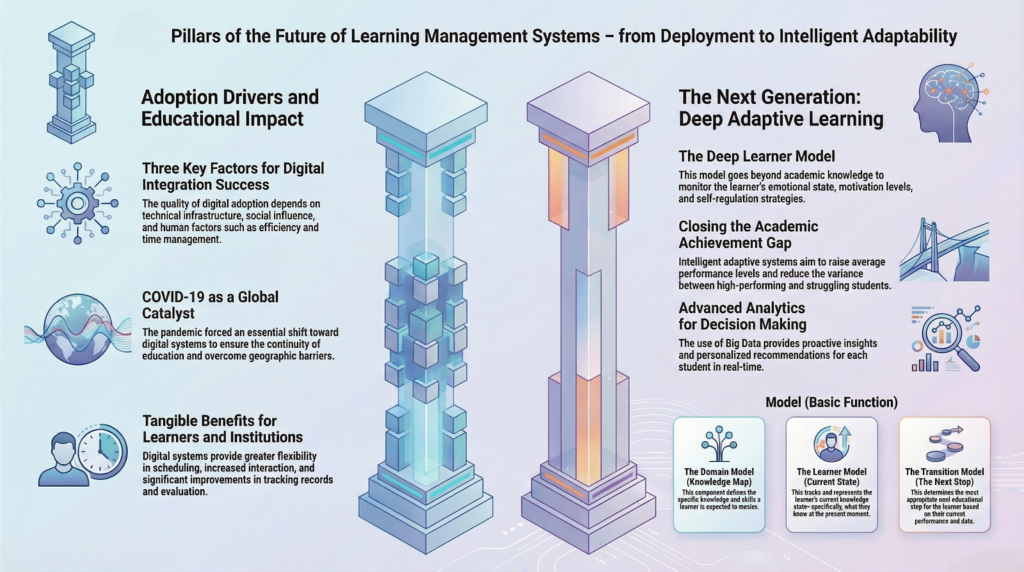
It should be emphasized that digital platforms promote various teaching and learning formats, such as cooperative learning and electronic brainstorming, thereby strengthening learners’ opportunities for self-directed learning. Furthermore, they enable and facilitate the implementation of the blended learning strategy, which combines face-to-face instruction and online learning and offers greater opportunities for interaction and more active engagement among learners. In addition, they can provide microlearning, which is based on short learning units, focuses on specific topics, and aligns with contemporary learning habits (Smyrnova-Trybulska, 2019).
Learning Management Systems (LMS) are web-integrable platforms that enable access to learning materials, the organization of communication, coordination and user management, as well as the creation of electronic assessments.
This is accomplished through learning pathways that, by means of immediate communication and the provision of multimedia content, address the principle of individualization and differentiation in instruction. In this way, these systems contribute to the promotion of a flexible learning environment (Herman et al., 2024).
Nevertheless, technical developments alone are insufficient to fully exploit digital education. The effective use of Learning Management Systems requires systematic pedagogical design, institutional support, and compliance with technical and organizational standards as well as data protection requirements. The advantages of digital systems become apparent only when they are combined with appropriate pedagogical concepts and comprehensive qualification and continuing-education programs (Gaaw & Stützer, 2017).
Recent developments indicate that Learning Management Systems are increasingly being enhanced by modern technologies. The deployment of artificial intelligence creates opportunities to design adaptive learning experiences tailored to learners’ needs, while gamification, the application of game-like elements, increases motivation and engagement.
Microlearning further enhances the efficiency of everyday, targeted learning. These trends are expected to play a decisive role in the advancement of digital learning environments and to expand the possibilities for more highly personalized and therefore more effective educational processes (Simon et al., 2025; Pribilová & Beňo, 2024).
Digital transformation contributes to a fundamental advancement of the education sector by increasing the effectiveness of traditional teaching methods through the integration of technological solutions and by establishing distanceLearning models as an effective option alongside face-to-face instruction within blended learning approaches.
Digital media enables flexible access to learning materials regardless of temporal and spatial constraints. This supports both synchronous and asynchronous learning and expands opportunities for interaction beyond the traditional classroom. Learning Management Systems (LMS) assume a key role as an integrated digital infrastructure, as they facilitate the development of courses, the tracking of academic performance, and communication among the involved stakeholders. LMS supports a diversity of learning strategies and the attainment of advanced learning outcomes (Herman et al., 2024).Learning Management Systems (LMS) are highly important for addressing heterogeneous learning needs by providing learning pathways that account for individual differences.
The use of multimedia content combined with interactive tasks and collaborative tools enhances the quality of the learning environment and the level of interaction and positively affects indicators of academic success. Empirical studies show that digital platforms can increase the efficiency of learning processes when their application is based on pedagogically informed principles (European Commission, 2020).
e-Learning has become an essential, integral component of modern education systems. Despite the considerable potential of digital technologies, their optimal use requires systematic pedagogical planning grounded in careful analysis to achieve the highest possible educational effectiveness. The digital transformation in the education sector represents a far-reaching development that goes beyond the mere integration of new technical tools. It depends on a deepened understanding of the relationships among technical infrastructure, pedagogical strategies, and institutional frameworks, thereby ensuring sustainable, future-oriented education.
The Concept of the Learning Management System and Its Significance
Learning Management Systems (LMS) are integrated digital platforms designed to systematically and effectively organize and further develop teaching and learning processes. They enable the management of learning content and the documentation of learning progress, and they promote communication and interaction between instructors and learners.
A Learning Management System is described as a software application used to administer, track, and monitor educational and training initiatives within institutions. It constitutes a virtual environment that connects instructors and students via a central online platform, thereby enabling the management of content, the delivery of instructional units, and the tracking of learning progress. It is also regarded as the starting point of any web-based educational program, since it provides a portal through which materials and instructional activities can be exchanged with ease (Akwene, 2024).
In their early phase, systems were limited to the administration of courses and learners. They have evolved since and now encompass a wide range of functions, including electronic assessments, discussion forums, and learning resource management. Learning Management Systems assume a central role in the digital education landscape by supporting structured learning and facilitating access to sources of knowledge. Current developments show an increasing integration of artificial intelligence, which analyzes learning and usage data and enables tailored learning offerings. At the same time, it supports instructors in responding effectively to individual learning needs (Hamadi & El-Den, 2023).
The development of learning management systems began in the late 1990s with the emergence of the first online learning platforms, which initially primarily provided materials. Over time, these systems evolved into integrated platforms with expanded functionalities. Today they include tools for collaborative learning, the administration of assessments, and assessment management. In doing so, they have established themselves as a fundamental component of modern learning environments (Otto et al., 2024).
Learning Management Systems (LMS) have become a central infrastructure of contemporary education, particularly in the context of eLearning. They are software applications for delivery, organization, and tracking of teaching and learning processes. LMS enables structured management of course content, the administration of tests, and communication between instructors and learners.
With the outbreak of the COVID-19 pandemic, the importance of LMS increased markedly. Educational institutions were compelled to convert teaching and learning processes into digital formats within a short period. This rapid transition revealed the need for effective and flexible platforms that support diverse learning activities while providing interactive and engaging learning environments.
The significance of these systems lies in their capacity to transform the traditional educational process of face-to-face instruction in conventional classrooms into an interactive digital distance Learning experience. They are characterized by the following features:
- High flexibility: Learners can access content at any time and from any location and proceed at their own pace.
- Increased interaction rates: The integration of multimedia elements (audio/video) enhances attention and motivation more effectively than traditional lectures.
- Cost efficiency: Reduction of travel, printing, and physical infrastructure costs for educational institutions and enterprises.
- Support for continuous learning: Rapid updating of training materials to adapt to market changes and to promote productivity.
- Improved communication: Promotion of collaboration and discussion beyond the boundaries of the classroom.
In this context, numerous Learning Management Systems with diverse functions and features have been introduced to ensure the continuity and quality of the educational process.
Functions of Learning Management Systems
The fundamental functions of Learning Management Systems (LMS) lie in the administration of courses and users. Instructors can structure courses, provide content, assign tasks, and organize examinations. User management enables tiered access rights for instructors, learners, and administrators, thereby strengthening system security and adaptability. Communication tools such as forums, chats, and videoconferencing promote exchange and interaction, which positively affect motivation and learning processes.
LMS are employed for the creation of digital courses, the development and administration of tests, assessment, and user management. Their central functions include the following.
- Course and Content Management
Creation, organization, and structured delivery of learning materials, as well as the regulation of learning processes within digital courses.
- User and Role Management
Administration of different user groups (instructors, learners, administrators) and the assignment of differentiated access rights.
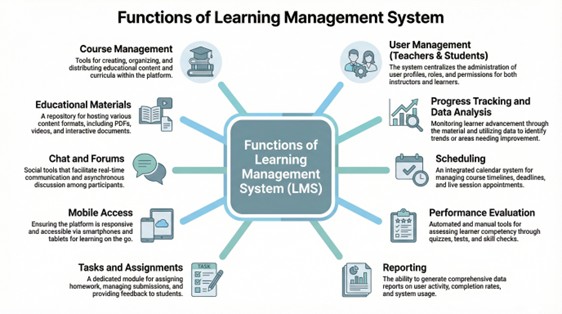
- Communication and Collaboration
Synchronous and asynchronous channels (discussion forums, chats, messages) to promote interaction and collaborative learning.
- Assessment, Assignment, and Grading Management
Administration of tests, submission of assignments, and documentation and evaluation of performance.
- Learning Progress Monitoring and Analytics
Logging of learning activities, reporting, and support for evaluation and analysis.
- Integration of External Tools and Media
Incorporation of multimedia content and external educational tools to create flexible, scalable learning environments (Simon et al., 2024; Learnteq, 2025; Abid et al., 2024).
Examples of Applied Learning Management Systems and Criteria for Their Use
Learning Management Systems function as central digital platforms for the organization, delivery, communication, and evaluation of teaching and learning processes in education and continuing education. There are different types, including open-source and commercial systems. Globally established systems include Moodle, Blackboard, Ilias, and Canvas.
Moodle as an open-source platform, is characterized by high flexibility and customizability. It is particularly suitable for institutions with diverse pedagogical requirements and ranks among the best-known and most widely used open-source systems worldwide.
Blackboard is widely used in higher education and offers an integrated suite of tools for course management and performance tracking. It has been criticized in part for usability issues; nevertheless, as a leading commercial system it provides comprehensive instruments for teaching and evaluation and is employed by many universities.
Google Classroom is a user-friendly platform that integrates Google educational tools and facilitates class organization.
Jusur is a national learning management system that has been used in Saudi universities under the supervision of the National Center for ELearning.
Brightspace is a cloud-based system offering a variety of tools for flexible, interactive learning.
Sakai is another example of an open-source system available to academic institutions (Arora & Bhardwaj, 2025; Akwene, 2024; Fearnley & Amora, 2020; al-Zahrānī, 2018).
Canvas has gained popularity due to its modern design, ease of use, and seamless integration of multimedia content. Its integrated analytics tools enable data-driven evaluations and targeted individual support.
Overall, these systems illustrate how Learning Management Systems support sustainable changes in knowledge transmission and promote a technology-enhanced, learner-centered educational approach. Future developments of Learning Management Systems are likely to be decisive for how digital learning environments are designed and used (Oudat & Othman, 2024).
To ensure interoperability and connectivity between different systems, several standards are employed in the development of Learning Management Systems, in particular: Standards Employed
- Caliper Analytics Standard (IMS) for the capture and analysis of learning activity data in LMS and educational platforms.
- Learning Tools Interoperability (LTI) Standard for the seamless integration of external learning tools with educational platforms.
- Learning Information Services (LIS) for the capture, organization, and provision of learning data to support education systems and decision-making processes.
- Question and Test Interoperability (QTI) Standard to ensure the exchangeability and compatibility of questions and tests across different assessment and learning platforms (Essa, 2016).
The significance of these standards lies in transforming learning systems from isolated data silos into open systems capable of exchanging data and external services. This transformation facilitates the development of personalized, flexible learning pathways grounded in advanced analytics. Moreover, these standards support a big data infrastructure that processes learning events and can provide immediate feedback to very large numbers of users simultaneously.
The Future of Learning Management Systems
The development of Learning Management Systems (LMS) in the education sector is increasingly shaped by Artificial Intelligence (AI). AI-driven features enable personalized learning pathways, the early detection of learning difficulties, and data-based support recommendations for instructors. These capabilities contribute to making teaching and learning processes more efficient, more targeted, and more inclusive, thereby addressing the diverse needs of learners (Liu & Huang, 2024; Patel, 2025).
In this context, the personalization of learning through AI is regarded as the next developmental step in digital education. AI has the potential to fundamentally change how content is presented and processed. As Learning Management Systems continue to evolve, the role of AI in education becomes increasingly important for enhancing learning experiences and achieving educational objectives more effectively.
Future Learning Management Systems are moving toward intelligent, adaptive learning environments that go beyond mere content storage. These systems will function as interactive environments that enable a fully individualized learning experience tailored to the needs of each learner.
Fundamental Characteristics of Future Learning Management Systems
Future systems should exhibit nine central characteristics to ensure their effectiveness:
- High accuracy: Continuous and precise capture of learner characteristics and current cognitive state.
- Efficient recommendations: Selection of the most appropriate resources and learning activities for each learner at the right moment of learning.
- Scalability: Support for very large numbers of concurrently active users through advanced cloud architectures.
- Flexibility and integration: Connectivity to other institutional systems based on open standards such as Caliper.
- Cost-effectiveness: Economic development, maintenance, and support.
- Inclusivity: Extension beyond STEM to encompass all disciplines.
- Transparency (open learner models): Making the performance model visible to learners to promote responsibility and self-regulation.
- Intelligent adaptivity through deep learner models: A holistic 360-degree view of learners across four dimensions:
- Cognitive dimension: Precise tracking of what learners know and do not know.
- Affective dimension: Monitoring of emotional states (e.g., confidence, frustration) to enable timely intervention.
- Motivational dimension: Measurement of effort and willingness to learn in order to provide appropriately tailored incentives.
- Metacognitive dimension: Strengthening learners’ awareness of their own learning and their ability to regulate the learning process.
- Adaptation mechanisms and dynamic pathways: Increasing learning efficiency through multiple approaches, including:
- Diagnostic pre-tests to identify knowledge gaps.
- Personalized learning pathways instead of linear sequences, potentially yielding substantial time savings.
- Immediate feedback with individual recommendations.
- Modularization of content into micro-learning objects.
- Integration of generative AI (e.g., ChatGPT) for personalized summarization and dialogic comprehension of complex ideas.
- Big-data analytics enabled by appropriate architectural approaches for real-time processing of large volumes of learning data and for providing predictive insights.
These systems will aim to “close the performance gap” by not only raising the overall level of achievement but by supporting lower-performing learners through intensive, personalized assistance, thereby reducing variance in learning outcomes (Essa, 2016; Cui et al., 2018).
Opportunities and Challenges
Modern technologies such as Artificial Intelligence, Virtual Reality, and Augmented Reality contribute to the expansion of digital learning spaces. They open greater opportunities for interaction, enable personalized learning environments, and support the individualization of education. These developments enhance the potential for tailored instructional designs and adaptive learning experiences (Bilquish, 2024).
Gamification has also promoted motivation and active engagement, particularly in the context of the COVID-19 pandemic. Embedding game-based elements into learning processes can increase motivation and willingness to learn. Reward systems, progress points, and competitions stimulate active participation and, when applied with sound pedagogical design, can produce positive effects on learning outcomes (Simon et al., 2025).
The ongoing digital transformation necessitates in depth investigation of technological innovations within Learning Management Systems. A solid understanding of their impacts on teaching and learning practice is essential for shaping future educational landscapes. At the same time, data protection emerges as a central concern. Personalized learning offerings rely on the processing of sensitive personal data, which elevates the importance of privacy and IT security. Compliance with legal requirements (e.g., the General Data Protection Regulation) and the implementation of technical safeguards are indispensable to secure trust and to mitigate risks such as data breaches or cyberattacks (Lazuardy et al., 2024; Bouke et al., 2023). A conscious and responsible approach to these challenges is a prerequisite for harnessing the possibilities of technological innovation in higher education in a responsible and sustainable manner (Gaaw & Stützer, 2017).
At the same time, the implementation and sustainable use of Learning Management Systems present institutions with central challenges. A stable technical infrastructure, suitable ending devices, and reliable internet connections are required. Continuous professional development programs for instructors are also crucial, since technological potential becomes effective only when applied with pedagogical intent. A lack of digital competencies or low acceptance among instructors and learners can substantially impair the use of Learning Management Systems (Simon et al., 2025).
Models such as the Technology Acceptance Model (TAM) provide in-depth insights into the acceptance of digital tools and their use. Developed by Davis (1989), TAM is one of the foundational reference models in management information systems research and is frequently used to explain factors influencing the adoption of new technologies. It assumes that the decision to adopt a technology is primarily determined by two central cognitive factors: perceived usefulness and perceived ease of use (Davis, 1989).
Digital learning environments simultaneously impose new demands on instructors, who must continuously develop both their technological and pedagogical competencies. Studies show that the success of Learning Management Systems depends largely on learners’ active engagement, the usability of the systems, and the close integration of pedagogical and technological aspects.
Global case studies reveal that the success of learning management systems relies heavily on their effective pedagogical embedding. Thus, the decisive factor is not the technology itself but its reflective application. Despite these challenges, Learning Management Systems offer considerable opportunities for more flexible and better-connected learning environments. They enable time- and location-independent learning, promote cooperative learning forms, support adaptation to diverse educational needs, and show positive effects in international case studies when integrated with sound pedagogy (Djigunović, 2012).
Future developments of Learning Management Systems are increasingly oriented toward adaptive learning technologies, learning analytics, and mobile learning. Artificial intelligence and machine learning enable dynamic adjustments of learning content, personalized recommendations, and the reduction of instructors’ administrative burden (Patel, 2025). Applications of virtual and augmented reality open new pedagogical possibilities by making complex content more tangible and experientially accessible. At the same time, the roles of instructors are changing they increasingly act as learning facilitators and coaches who use data-based support to effectively steer learning pathways (Smyrnova-Trybulska, 2019; Walter, 2024).
As the cited sources indicate, Learning Management Systems have become a central component of modern educational processes, particularly against the backdrop of accelerated digitalization. This contribution highlights the functions, development, and significance of Learning Management Systems, as well as the influence of technological innovations on teaching and learning processes. It also points to challenges concerning didactic-methodological integration, technical complexity, and data protection requirements.
Overall, it is evident that Learning Management Systems substantially contribute to the advancement of digital learning environments. However, realizing their potential requires continuous, reflective integration based on critical engagement.
Requirements for Digital Transformation in Swaida
The reality of the educational sector in Swaida reveals a clear divergence between societal aspirations manifested in the high value placed on children’s education and relatively high rates of academic attainment and the current practical challenges. In this context, Learning Management Systems (LMS) emerge as a pragmatic solution. These systems provide a digital learning environment that transcends spatial and temporal constraints, helps mitigate infrastructure shortfalls, and ensures learners’ access to educational content.
Field data indicate that Swaida’s educational infrastructure has experienced a marked deterioration, particularly following the July massacre of the previous year, as indicated by international reports (OHCHR, 2025).
This deterioration is evident in the shortage of schools due to the conversion of some facilities into shelters, the disruption of university branches, and the accumulation of pre-existing problems that afflicted the educational sector prior to the crisis. Renting geographically dispersed buildings that are not equipped for higher education has created difficulties for student and faculty mobility, wasted time, weakened academic coordination, and unequal access to educational resources. These factors have negatively affected the continuity and quality of the educational process.
Considering these challenges, Learning Management Systems assume a central role in building a more resilient educational system capable of withstanding crises. Implementing such systems requires attention to the following requirements.
- Legal and Regulatory Requirements:
Legal and regulatory requirements constitute the cornerstone of any successful digital transformation, especially in fragile educational environments. It is necessary to adopt clear policies for the collection, storage, and archiving of student data. Precise mechanisms for consent and for controlling access privileges within the system must be established, along with clearly defined user roles. These measures reduce the risk of privacy violations and data misuse. Additionally, adopting educational quality management standards is essential to ensure continuous improvement and transparency of performance.
- Pedagogical and Methodological Requirements:
Curricula should be redesigned and linked to measurable learning outcomes. Content must be converted into interactive digital learning units that include audiovisual materials and clearly defined assessment activities. This transformation requires ongoing teacher training programs in digital lesson design, virtual classroom management, and the use of electronic assessment tools. Continuous technical support must also be provided.
Digital materials should be produced in file sizes suitable for uploading and downloading, facilitating access in environments with weak Internet connectivity. It is also important to adopt diverse eLearning modalities, including synchronous and asynchronous learning, to ensure continuity of learning and equity of opportunity.
- Technical Requirements:
The technical infrastructure must include flexible and customizable Learning Management Systems. Preference should be given to free open-source platforms such as Moodle due to their flexibility and low licensing costs. High-capacity servers and robust data backup policies are required to enable data recovery in emergencies. Cybersecurity standards must be observed to protect data and maintain system integrity.
Investment in alternative power solutions is necessary to provide electricity amid persistent outages. Satellite Internet or local network solutions should be considered to ensure continuous access to the system when conventional Internet service is interrupted or of poor quality.
- Integration of Artificial Intelligence Tools:
Integrating artificial intelligence tools can enhance the design of educational content and personalize the learning experience. Artificial Intelligence (AI) can generate auxiliary educational resources, design learning tasks that account for students’ educational needs and individual differences, and provide instructional recommendations based on analysis of learner performance data.
However, caution is required when using AI. Content generated by AI tools must be reviewed by specialists. Ethical and legal standards and controls for AI use in the educational context must be established.
Rekommandation
- Establish a clear legal framework for data protection and the delineation of responsibilities, including emergency response and data recovery plans.
- Adopt educational quality standards that link curricula to measurable outcomes and support diverse forms of eLearning.
- Prefer open-source, customizable Learning Management Systems tailored to institutional and educational needs, and invest in secure, scalable infrastructure.
- Implement continuous teacher training programs and provide ongoing support.
- Set ethical and legal controls for integrating AI tools into the Learning Management System and adopt mechanisms for specialist human review of AI outputs.
Applying these requirements represents a substantive step toward building a flexible digital learning environment. Such an environment can mitigate the effects of the geographic dispersion of university faculties and compensate for shortages in infrastructure and teaching staff at the primary and secondary school levels. This will help ensure the continuity and quality of the educational process in Swaida.
Digital transformation here is not merely a technical option; it is an educational and developmental necessity to ensure the resilience and sustainability of the educational system under the exceptional circumstances facing Swaida.
Summary
This article addresses digital transformation in the education sector, with a focus on Learning Management Systems as a central infrastructure in contemporary education. These systems constitute an integrated technical and organizational framework that overcomes traditional constraints of time and place, enabling learners to access educational resources at any time and from any location.
Learning Management Systems combine content delivery, administrative process organization, and support for interactive communication between teachers and learners. They also promote collaborative work and self-directed learning. Together, these features help establish flexible digital learning environments that respond to diverse learner needs and support lifelong learning continuity.
Over recent decades, Learning Management Systems have undergone significant development. They have evolved from simple digital platforms whose function was limited to making educational materials available and downloadable, into complex, integrated educational systems offering a wide range of advanced functions. These functions include tools for synchronous and asynchronous interaction, electronic assessment mechanisms, progress-tracking systems, and analytics capabilities that collect precise data on learning patterns and learner behavior.
Innovative technologies such as artificial intelligence, gamification techniques, and microlearning expand the pedagogical potential of adaptive Learning Management Systems. They enhance learner motivation, improve the quality of interaction, and support the achievement of more effective learning outcomes.
At the same time, the article emphasizes that the success of Learning Management Systems is not determined by technological advancement alone. Success depends substantially on their didactic deployment grounded in clear pedagogical principles. Teacher preparation and the provision of necessary digital competencies are essential conditions for optimal utilization of these systems. Equally important are supportive institutional and regulatory frameworks, which include clear digital transformation strategies, reliable technical infrastructure, and sustained administrative support.
The article also examines the requirements for digital transformation in the education sector in Swaida. The transformation process requires a clear legal and regulatory framework that protects student data, defines access privileges, and includes emergency response and data recovery plans. It necessitates redesigning curricula into digital formats linked to measurable outcomes and producing interactive learning units, accompanied by continuous training and technical support for teachers.
The technical infrastructure must include flexible, customizable Learning Management Systems and secure servers that adhere to cybersecurity standards. Investment in energy and communications infrastructure is necessary to ensure continuous access to the system amid power outages. The article further stresses the importance of integrating artificial intelligence tools within ethical and legal safeguards, together with human review of AI outputs, to ensure quality and personalization of learning without compromising standards.
References
الزهراني، عماد جمعان عبد الله. (2018). أثر اختلاف نمط الاتصال في أنظمة إدارة التعلم الإلكترونية على تحصيل المفاهيم العلمية لتكنولوجيا التعليم لطالب كلية التربية بجامعة الباحة. مجلة كلية التربية بجامعة الخرطوم، العدد (8)، 67-108
Abid, A., Tufail, A. H., Salem, O. M. A., Nawaz, N. A., Farooq, U., Abid, I., & Ishaq, K. (o. J.). An evaluation framework and comparative analysis of the widely used learning management systems. https://doi.org/10.1371/journal.pone.0311111
Akwene, G. C. (2024). Adoption of Learning Management Systems in Higher Education: A Qualitative Analysis of Enabling Factors. International Journal of Scientific Research and Management (IJSRM), 12(02), 3229-3237. https://pdfs.semanticscholar.org/9026/c926918f024a19cfd850177df5d855ce1a94.pdf
Bouke, M., Alshatebi, S. H., Abdullah, A., Cengiz, K., & Atigh, H. E. (2023). African Union Convention on Cyber Security and Personal Data Protection: Challenges and Future Directions. In ArXiv: Vol. abs/2307.01966. ArXiv. https://doi.org/10.48550/arXiv.2307.01966
Cui, W., Xue, Z., & Thai, K. P. (2018, November). Performance comparison of an AI-based adaptive learning system in China. In 2018 Chinese automation congress (CAC) (pp. 3170-3175). IEEE. DOI:10.1109/CAC.2018.8623327 https://www.researchgate.net/publication/331426195_Performance_Comparison_of_AI-Based_Adaptive_Learning_Systems_in_China
Davis, F. D. (1989). Perceived usefulness, perceived ease of use, and user acceptance of information technology. MIS Quarterly, 13(3), 319–340. DOI:10.2307/249008 https://www.researchgate.net/publication/200085965_Perceived_Usefulness_Perceived_Ease_of_Use_and_User_Acceptance_of_Information_Technology
Djigunović, J. M. (2012). Dynamics of Learner Affective Development in Early FLL. In Studies in Second Language Learning and Teaching (Vols. 2, pp. 159-178). Studies in Second Language Learning and Teaching. https://doi.org/10.14746/SSLLT.2012.2.2.2
Essa, A. (2016). A possible future for next generation adaptive learning systems. Smart Learning Environments, 3(16). https://doi.org/10.1186/s40561-016-0038-y
European Commission. (2020). Digital Education Action Plan (2021–2027): Resetting education and training for the digital age. Publications Office of the European Union. https://education.ec.europa.eu/focus-topics/digital-education/plan
Fearnley, M. R., & Amora, J. T. (2020). Learning management system adoption in higher education using the extended technology acceptance model. IAFOR Journal of Education: Technology in Education, 8(2), 89–106. https://doi.org/10.22492/ije.8.2.05
Gaaw, S., & Stützer, C. M. (2017). Learning und Academic Analytics in Lernmanagementsystemen (LMS): Herausforderungen und Handlungsfelder im nationalen Hochschulkontext (1–, p. 208). https://www.researchgate.net/publication/334773020_Learning_und_Academic_Analytics_in_Lernmanagementsystemen_LMS_Herausforderungen_und_Handlungsfelder_im_nationalen_Hochschulkontext
Gladun, M., Nastas, D., & Spivak, S. (2018). FORMATION OF DIGITAL COMPETENCE OF FUTURE TEACHERS OF ELEMENTARY SCHOOL USING BLENDED LEARNING AND PERSONAL LEARNING ENVIRONMENT (pp. 58-65). https://doi.org/10.28925/2414-0325.2018.5.5865
Hamadi, M., & El-Den, J. (2023). A conceptual research framework for sustainable digital learning in higher education. In Res. Pract. Technol. Enhanc. Learn. (Vols. 19, p. 1). Res. Pract. Technol. Enhanc. Learn. https://doi.org/10.58459/rptel.2024.19001
Herman, V., Hromova, N. V., & Kіrіlenko N. I. (2024). LMS Moodle as an information and digital technology for distance learning of philology students: from the experience of use. In THE LATEST DEVELOPMENT TRENDS IN PHILOLOGICAL SCIENCE AND EDUCATION. THE LATEST DEVELOPMENT TRENDS IN PHILOLOGICAL SCIENCE AND EDUCATION. https://doi.org/10.30525/978-9934-26-404-7-53
Lazuardy, M. S., Rachmawati, M., Marlina, T., & Umar, J. (2024). Legal framework for protecting bank customers against personal data leakage in the digital era: A study of Indonesian regulations. In Indonesian Journal of Multidisciplinary Science. Indonesian Journal of Multidisciplinary Science. https://doi.org/10.55324/ijoms.v3i10.907
Learnteq. (2025, 7. Juli). Lernmanagementsystem (LMS) erklärt: Definition, Nutzen & Einsatz. Abgerufen von https://www.learnteq.de/lms-erklaert-definition-nutzen-einsatz/
Liu, Z., & Huang, Y. (2024). Innovation in Ideological and Political Education and Personalized Learning Paths in the Era of Artificial Intelligence. In International Journal of New Developments in Education. International Journal of New Developments in Education. https://doi.org/10.25236/ijnde.2024.060528
Office of the United Nations High Commissioner for Human Rights. (2025, August 21).
Syria: UN experts alarmed by attacks on Druze communities, including sexual violence against women and girls.
https://www.ohchr.org/en/press-releases/2025/08/syria-un-experts-alarmed-attacks-druze-communities-including-sexual-violence [ohchr.org]
Otto, S., Markman, A. O., & Svarre, T. (2024). Critical success factors for Learning Management Systems in higher education. In Networked Learning Conference. Networked Learning Conference. DOI:10.54337/nlc.v13.8501 https://www.researchgate.net/publication/382726196_Critical_success_factors_for_Learning_Management_Systems_in_higher_education_A_literature_review
Oudat, Q., & Othman, M. (2024). Embracing digital learning: Benefits and challenges of using Canvas in education. In Journal of Nursing Education and Practice. Journal of Nursing Education and Practice. https://doi.org/10.5430/jnep.v14n10p39
Patel, A. (2025). Revolutionizing STEM Education: The Impact of AI-Powered Mobile Applications on Personalized Learning. In INTERNATIONAL JOURNAL OF ADVANCED RESEARCH IN ENGINEERING AND TECHNOLOGY. INTERNATIONAL JOURNAL OF ADVANCED RESEARCH IN ENGINEERING AND TECHNOLOGY. https://doi.org/10.34218/ijaret_16_01_016 PDF abgerufen von: https://www.tuv.com/
Pribilová, K., & Beňo, M. (2024). New Trends in ELearning and New Approaches to the Development of Elearning Educational Materials. In Pedagogical Diplomacy II DOI:10.53349/resource.2024.is1.a1255 https://www.researchgate.net/publication/378764862_New_Trends_in_ELearning_and_New_Approaches_to_the_Development_of_ELearning_Educational_Materials
Simon, P. D., Jiang, J., Fryer, L. K., King, R. B., & Frondozo, C. E. (2024). An Assessment of Learning Management System Use in Higher Education: Perspectives from a Comprehensive Sample of Teachers and Students. Technology, Knowledge and Learning, 30(2), 741–767. https://doi.org/10.1007/s10758-024-09734-5
Smyrnova-Trybulska, E. (2019). ELEARNING – EVOLUTION, TRENDS, METHODS, EXAMPLES, EXPERIENCE. In International Conference eLearning(1–, p. 155). International Conference eLearning. DOI:10.33965/el2019_201909F020 https://www.researchgate.net/publication/335369541_ELEARNING_-_EVOLUTION_TRENDS_METHODS_EXAMPLES_EXPERIENCE
Strohmeier, S. (2008). Informationssysteme im Personalmanagement: Architektur – Funktionalität – Anwendung. Vieweg+Teubner Verlag. https://doi.org/10.1007/978-3-8348-9475-5
Walter, Y. (2024). Embracing the future of Artificial Intelligence in the classroom: the relevance of AI literacy, prompt engineering, and critical thinking in modern education. In International Journal of Educational Technology in Higher Education (Vols. 21, pp. 1-29). International Journal of Educational Technology in Higher Education. https://doi.org/10.1186/s41239-024-00448-3 https://doi.org/10.54337/nlc.v13.8501