

Aldebs, Mohannad et al. (2026).
Abstract
In light of the current reality and the critical circumstances through which Swaida is passing, and the acute deterioration witnessed in basic services, particularly in the electricity sector, severe electricity rationing has had profound repercussions. In some periods, this rationing has reached 22 hours of daily power cuts in most areas of Swaida.
This situation stems from the water system’s fundamental dependence on deep groundwater wells, which in many cases reach depths of approximately 700 meters. This makes their operation contingent upon the consistent supply of electrical power.
Faced with this reality, an urgent need emerged to seek alternative and rapid solutions, embodied in the shift toward establishing photovoltaic power supply plants to secure the power supply necessary to operate the wells. This represents an emergency solution in the short term and a sustainable and supportive option should there be improvement or a partial return to reliance on the public electrical grid in the future.
This article presents a concise summary of the current status of Swaida’s water wells and presents four practical case studies of photovoltaic power stations for powering water wells with electrical energy.
In addition to presenting the numerous advantages of establishing such stations, the article provides technical and economic comparisons between the selected examples. Furthermore, the article emphasizes the role of good local governance in such projects and proposes solutions concerning the ownership and maintenance of these stations, as well as the regulation of future relationships with relevant stakeholders.
At the conclusion of this article, a number of important recommendations are presented, which would contribute to promoting the stability of the electrical grid’s operations in light of the proliferation of photovoltaic power supply projects. Additionally, the article highlights the importance of social solidarity and popular participation in this type of project.
Note: All technical and financial calculations presented in this article are examples from certain practical experiences and should not be considered as references for other applications. Detailed technical and financial calculations must be conducted according to the specific data of each project.
Introduction: Water and Electricity Crisis in Swaida and Possible Solutions
Swaida depends on deep groundwater wells as its primary source for drinking water and irrigation. Swaida contains more than 300 wells operated by the Water Authority, in addition to agricultural and private wells. The depth of more than two-thirds of these wells exceeds 400 meters, which necessitates the use of high-capacity vertical pumps. submersible pumps with capacities of 125 or 150 horsepower are used in more than 60% of the aforementioned wells in order to achieve pumping discharge rates generally ranging between 20 and 30 cubic meters per hour. The majority of drinking water wells are located relatively far from the main water tank of the town or neighborhood, which necessitates two-stage water pumping: the vertical pump transfer water from the well to a local tank adjacent to the well; then, in the second stage, a horizontal pump pumps water from the local tank to the main tank of the town or neighborhood. The capacity of the horizontal pumps is fundamentally related to the distance between the two tanks and the difference in elevation between them, and the capacities used for this purpose may range between 75 and 10 horsepower. Thus, the majority of wells require a total electrical capacity ranging approximately between 90 and 150 kW per well.
The wells were designed to be supplied from the public electrical grid as a primary power source. However, due to the acute electricity crisis in Syria over the past fifteen years—which has reached its worst stages currently in Swaida, with rationing reaching 22 hours daily—Identifying alternative energy solutions has become an urgent priority. This has led to the use of backup diesel generators in some wells as the primary power source, the connection of the non-rationed line (the so-called “golden line”) to others, or the installation of a photovoltaic plants near the well. The burden of implementing these projects generally falls upon the local community with the assistance of diaspora members or some humanitarian organizations.
In mid-July 2025, Swaida Governorate witnessed a large-scale military escalation, represented by the entry of forces belonging to the de facto authority based in Damascus, alongside allied armed groups, into the city of Swaida and approximately 42 villages located to its north, west, and south.
This attack resulted in widespread destruction of the urban infrastructure. Local estimates indicate the destruction or burning of more than 25,000 residential units, in addition to the displacement of large numbers of the population. The damage also affected vital infrastructure, particularly water wells, with a large number of them subjected to destruction or equipment damage and theft, resulting in approximately 40% of the governorate’s wells being taken out of service.
This has contributed to the aggravation of the drinking water crisis, especially in areas that remained outside the scope of direct clashes, which have witnessed increased population density as a result of population displacement, particularly the city of Swaida. It should be noted that the city relies heavily on wells and pumping stations located in the vicinity of the town of al-Tha’ala, all of which fell out of control during the escalation period.
Days after the attack, the attacking forces withdrew from the city of Swaida and some surrounding villages. However, at the time of preparing this study, they remain stationed in approximately thirty villages that have suffered widespread destruction and complete population displacement. The attached map shows the contact lines of the clashes and the villages that remain under the control of forces belonging to the government in Damascus.
Figure 1: Map of Swaida Showing Villages and Towns That Remain Under the Control of the Damascus Government Authority
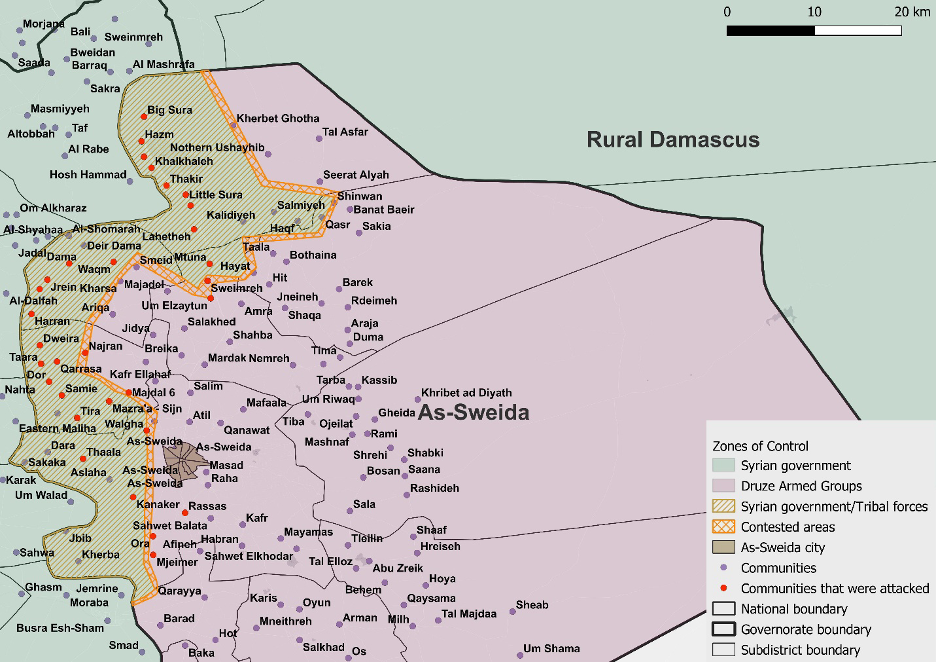
Source: Truth Trend https://truthtrend.me/en/destruction-and-siege-drive-as-sweida-into-a-deepening-humanitarian-crisis
The map has been changed to show English names and the link as well
Current Status of Water Supply in Swaida City
Regarding the city of Swaida, according to information obtained in mid-September—approximately two months after the invasion the city was able to secure approximately one-third of its customary drinking water needs, estimated at approximately 7,000 cubic meters out of approximately 20,000 cubic meters daily. This quantity is provided through 23 remaining wells within the city and its surroundings, after 21 wells in the village of al-Tha’ala, west of the city, fell under the control of the attacking forces and were subjected to theft and sabotage. Additionally, the al-Rum Dam station has been out of service since before the attack due to the decline in water levels in the dam.
Currently, approximately half of the remaining operational wells within Swaida city are supplied with electrical power from the non-rationed public grid, while the other half rely on the rationed public grid or diesel generators. These sources, in their various forms, constitute unsustainable solutions in the medium and long term, given their instability and the high costs of their operation, in addition to their subjection to centralized administrative and political considerations, a reality that became increasingly evident following these conditions apply equally to water wells in the villages and towns of the governorate, which suffer from the same problems related to the very low reliability in electrical supply and elevated operational costs. In this context, photovoltaic power systems emerged as a more reliable and sustainable option in light of the current crisis, in addition to being more economically efficient compared to other alternatives, which require high operational expenses, whether related to fuel (diesel) or electricity bills, particularly in the case of reliance on what is known as high-tariff electrical lines (such as the “golden line”).
Photovoltaic Energy for Powering Water Wells
Swaida is considered one of the favourable regions for utilising photovoltaic energy, as the average daily solar radiation in Swaida is estimated at approximately 4.66 peak sun hours (PSH = 4.66 h), combined with moderate temperatures in the region, which increases efficiency.
In order to clarify the technical and economic feasibility of powering water wells with photovoltaic energy, one can consider an illustrative example of a deep well with a submersible pump of 150 horsepower capacity and a horizontal pump of 35 horsepower capacity—that is, a total capacity of 185 horsepower, equivalent to approximately 138 kW of electrical power. Taking into account a factor of 1.8 for the photovoltaic field, the required capacity would be approximately 248 kW. If a variable frequency drive inverter (VFD inverter) compatible with the submersible pump is utilised, the average daily operating hours throughout the year could reach approximately 6-7 hours daily. With the assumption of a pumping discharge rate of 25 m³/h, the water production of the well using solar power supply would be approximately 150-175 m³ daily. Assuming that the minimum clean water for personal needs is 50 liters daily (according to the United Nations), the well’s production would meet the minimum clean water needs of approximately 3,500 people for personal use. Further technical details regarding this example can be found in the global solar atlas database.
Assuming the installation of fixed photovoltaic power panels without a maximum power point tracking system, oriented south at an angle of 23 degrees, and considering a panel capacity of 645 W, the number of required panels would be 385 panels. This example proposes the use of a hybrid inverter of 185 kW capacity for the submersible pump and 55 kW capacity for the horizontal pump.
The approximate cost of electrical equipment for the photovoltaic power field at the aforementioned capacity according to this example (248 kW) is approximately $42,000. In addition to the costs of construction work and metal supports, which depend heavily on the distribution of the panels within the available space and the angle of inclination, as well as labor costs, the final cost could reach approximately $60,000–70,000. The following table presents an illustrative example of the estimated costs for a photovoltaic plant according to the data mentioned above.
Table 1 – Approximate Cost for Implementing a Photovoltaic Power Plant with a Total Capacity of 248 kW
(Calculated in the case of a specific practical example and not generalizable to other projects)
| No. | Item | Approx. Total Cost (USD) |
| 1 | Civil Preparation Works | $2,000 |
| 2 | Metal Mounting Structures | $19,000 |
| 3 | Solar Panels (385 units) | $28,000 |
| 4 | Inverters | $5000 |
| 5 | DC Cables, protection and control | $7000 |
| 6 | Installation Labor | $5,000 |
| 7 | 3-Phase Reactor Filter | $1000 |
| Total | $67,000 |
To illustrate the economic efficiency of the solution, one can compare the capital cost of the photovoltaic plant with the operating cost via a diesel generator with a capacity of (250 kVA, 200 kW). The approximate fuel consumption of the generator at the mentioned load (i.e., 138 kW) is 38 liters per hour, which equals 228 liters over six hours (as the average time for daily solar power operation). Considering the current cost per liter at $1, the fuel cost of the generator would be approximately $83,000 annually, which exceeds the capital expenditures (CAPEX) of the photovoltaic power plant.
An alternative approach can be used to demonstrate economic efficiency when compared with the kilowatt-hour price for institutions, based on the current price list of the Ministry of Energy, which is 1,700 SYP per kilowatt-hour, equivalent to approximately $0.145. Consequently, the cost of electricity required to operate the well for one hour would be approximately $20, equivalent to $44,000 annually, based on six hours of daily operation. This means that the capital expenditures (CAPEX) of the solar field could be recovered within one and a half years through savings on electricity costs from the public grid (of course, in case of availability).
Furthermore, photovoltaic energy in the mentioned example contributes to reducing carbon dioxide emissions by approximately 220 tons annually when compared with the use of a diesel generator, considering that each liter of diesel causes the emission of 2.65 kg of carbon dioxide and based on six hours of daily operation. In contrast, the reduction in emissions when using the electrical grid amounts to approximately 210 tons annually, assuming that public generation is carried out through thermal power plants powered by natural gas and based on average emissions of 0.7 kg per kilowatt-hour. This is offset against an average value of carbon dioxide emissions of 12 tons annually from the use of solar energy (resulting primarily from the manufacturing process).
Practical Experiences
Swaida has witnessed, over the past several months, an accelerating increase in the implementation of photovoltaic power projects for powering service sectors, particularly water wells. Generally, the burden of studying, financing, implementing, and operating these projects falls upon the local community with direct interest, in cooperation with diaspora groups from the concerned region or associations of Swaida’s diaspora and some donor organisations. This is due to the limited capacity of the state to fulfil its service function and its arrangement of priorities in a manner that prioritises its own security considerations at the expense of public services. In this context, it is observed that basic services have been transformed, in different phases, into a tool of pressure exercised against local communities, whether during the period of previous regimes or in the current phase.
As a result, the local community has gradually assumed an increasingly significant role in compensating for this service gap over the past years. This role manifested in progressive initiatives that included supporting schools with supplies and heating means, securing some health services and medicines, and extending to the provision of alternative sources of electrical power for vital facilities, such as hospitals, communication centres, and water wells.
This section reviews four recent local experiments as examples of projects to power water wells with photovoltaic energy in the villages of Murdok, Bakka, and al-Qrayya, in addition to the city of Swaida.
Murdok
The village population is approximately 5,000 people distributed across approximately 1,600 families. Well No. 2 was selected for the installation of a photovoltaic system due to its location in an inhabited area, which provides greater security for the equipment, as well as the availability of sufficient space for installing photovoltaic panels in the immediate vicinity of the well. The well depth is 615 m and uses a submersible pump with a capacity of 125 HP, capable of pumping water at a discharge rate of approximately 25 m³/h. There is a local tank near the well with a capacity of 50 m³, located approximately 1,200 m from the main town tank, with a height difference of about 100 m between the two tank levels, necessitating the use of two horizontal pumps each with a capacity of 40 HP, operating alternately to pump water to the main tank. According to the study prepared by the “Hawkama” (Governance) team using a factor of 1.8, the required field capacity is 222 kW, of which approximately 168 kW is for powering the submersible pump and the remainder for the horizontal pump. The panel layout was designed at an angle of 23° facing south. In the event that the well operates on average for 6 hours daily via photovoltaic energy at a discharge rate of 25 m³/h, it could provide approximately 60% of the minimum clean water needs of the village’s residents. The project was divided into several phases. The first and second phases, which include full powering of the horizontal pump and implementation of the construction work for the photovoltaic field of the submerged pump, have been executed, and work is currently being monitored in the third phase of the project.
Swaida City – Well No. 4
The depth of this well is 625 m and uses a submersible pump with a capacity of 125 HP and a horizontal pump with a capacity of 75 HP. Considering that the well contributes, along with other wells, to supplying a large section of the city’s population with clean water, the number of beneficiaries is approximately 75,000 people. The technical study proposed by Fiona Renewable Energy Company recommended the installation of a photovoltaic field with a total capacity of 194 kW, of which 129 kW powers the submersible pump and the remainder powers the horizontal pump. The total number of panels used is 315 panels with a capacity of 615 W per panel. The panels were installed at an angle of 23° facing south over an area of approximately 1,400 m², and the system was put into service on December 7, 2025. It currently provides a pumping discharge rate of approximately 30 m³/h.
Bakka Village
The well depth is 600 m and uses a submersible pump with a capacity of 150 HP in addition to a horizontal pump with a capacity of 20 HP. The well contributes to providing clean water for approximately 5,000 people living in the village. The solar field was studied and implemented by Horizon Energy Company with a total capacity of 235 kW, of which 209 kW powers the submersible pump and the remainder powers the horizontal pump. The total number of panels used in the project was 332 panels with a capacity of 630 W per panel. The panels were installed at an angle of 7° facing south in order to optimize the space used, which amounted to 900 m². The system was successfully put into service in mid-December 2025.
Al-Qrayya
The village population is approximately 12,000 people distributed across approximately 2,900 families. The well selected for the installation of the photovoltaic system is located east of the village, approximately 600 m from the main tank, with sufficient space in its vicinity for installing the photovoltaic system. The well depth is 665 m and uses a submersible pump with a capacity of 150 HP. The local tank capacity for the well is 50 m³, and due to its proximity to the main tank, a horizontal pump with a capacity of 10 HP is sufficient to pump water to the main tank. Al-Noor Company prepared the technical study and implemented the project by installing a system with a capacity of approximately 221 kW, of which approximately 200 kW powers the submersible pump and the remainder powers the horizontal pump. The panel layout was designed at an angle of 32° facing south. It is expected to contribute to operating the well for a duration ranging between 4 hours daily in winter and reaching 9 hours in summer via photovoltaic energy at a discharge rate of 30 m³/h, which could provide approximately 30% of the minimum clean water needs of the village’s residents. The part relating to the submerged pump was successfully implemented and tested on December 26, 2025, and work is currently underway on the remaining part relating to the horizontal pump.
Comparative Analysis of the Four Practical Experiences
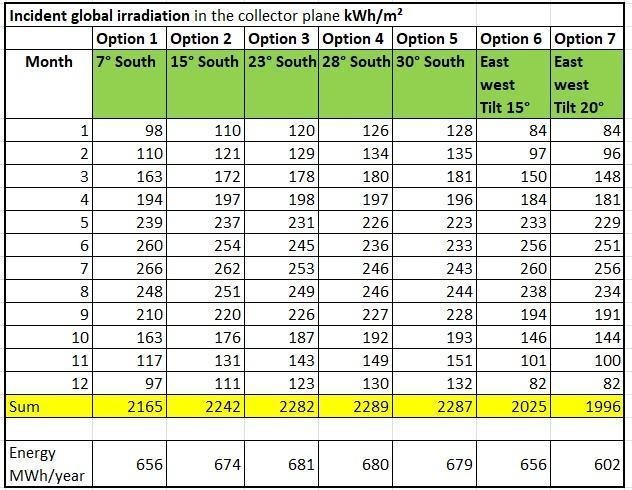
From the study of the four previous experiences, it is evident that the total required capacity is converging and ranges from 193 kW to 235 kW, utilizing photovoltaic capacity with a factor ranging between 1.4 and 1.87, and panel tilt angles that vary according to space availability, ranging from 7° to 32°, all oriented toward the south. The following table, taken from a comparative study conducted by the “Governance” team, shows the impact of the angle and orientation of solar panels on the energy yield from the photovoltaic field. It is clearly evident that the difference between the least productive option and the most productive option among the seven studied options does not exceed 13% with respect to the overall yield throughout the year, with preference for angles of 23°–30° facing south. Meanwhile, the yield in summer months shows higher performance at lower angles facing south or east-west. These limited differences allow high flexibility when designing the distribution of panels according to available space conditions.
Table 2 – Comparison of the Impact of Solar Panel Angle and Orientation on Energy Yield from the Photovoltaic Field
Practical Experiences from the Perspective of Good Local Governance
In this section, attention is directed toward certain aspects of good local governance that accompanied these projects and the innovative solutions for their management and organization.
Project Financing
The financing of the four mentioned experiments ranges between $57,000 and $68,000 per project, depending on the installed capacity and distribution and location of the panels, as well as current prices at the time of project implementation. The actual cost per photovoltaic kilowatt ranges between $0.25 and $0.31 per kilowatt. The financing of these projects relied on donations from the local community or support from organizations of Swaida’s diaspora or humanitarian organizations, or a combination of these resources.
From the experience of the “Hawkama” team and the civil society in Murdok, the financing of the first three phases of the project is being conducted by two external donor organizations after a comprehensive document and project definition was presented, encompassing social, administrative, geographical, technical, and financial studies, in addition to economic feasibility. Communication with donor organizations continues with the objective of securing sufficient financing to complete the project.
As for Bakka village, financing was based entirely on the local community, particularly the village’s diaspora, in addition to community contribution to implementation work, donation of the land necessary for the field, and the implementing company’s donation of all labor costs.
The project of Swaida’s Well No. 4 was financed by the Sanad Association in cooperation with the Druze Saxony Association and one other donor organization. A team of university students, and technicians volunteered to assist in the implementation and operation of the project.
In al-Qrayya, half of the required financing was collected from community donations and the other half from a donor organization. Additionally, significant cost savings were achieved through the community’s contribution to volunteer work, such as labor costs for installing mounting system and construction work and the implementing company’s labor costs, in addition to project management and supervision being conducted voluntarily by the village’s Unified Financial Committee.
Project Management and Popular Work
From the “Governance” team’s experience in studying and implementing Murdok village’s well, a voluntary team was formed consisting of a group of active young people from the village with experience in popular work and social activism. The management team included an organizational structure represented by a project manager, an assistant manager, an engineering team, a lawyer, an accountant, a procurement officer, and representatives from the municipality and from the charitable society.
This team assumed the following tasks:
- Presenting initial estimates of the study based on the village’s water needs based on population statistics and the agricultural and livestock consumption needs of the village.
- Providing engineering and technical information related to the well, tanks, and pumping.
- Securing a site for the plant, which required obtaining approval to use a former government property, in addition to neighboring land provided by donors.
- Participation in the technical and financial study of the solar plant.
- Procurement and implementation.
During the implementation phase, the administrative team was committed to distributing work with the objective of involving multiple workers and craftsmen from the village rather than limiting it to specific individuals. The purpose of this procedure is to involve the largest possible segment of the village’s population in implementing the station to promote a general sense of collective ownership in the village and to document popular and social cooperation.
The administrative team holds periodic meetings during which it presents the requirements of each step and obstacles, proposes solutions, and works to implement them.
The administrative team provides a periodic report on each step in the form of meeting minutes signed by the team. It also submits work progress and achievement reports to the “Hawkama” team and to donor organizations, documenting work stages, procurements, and the financial reports.
Project Ownership
From the “Hawkama” (Governance) team’s experience in studying and implementing Murdok village’s well, it was proposed that complete project ownership be transferred to the village’s residents represented by the charitable society. A document was formulated in this regard that specifies ownership of the project land as well as the perimeter and roofs of an abandoned carpet factory belonging to the Ministry of Social Affairs and Labor, from which the necessary approvals were obtained for use, in addition to neighboring land that was provided to the project by its owners. The ownership document is currently being reviewed legally by lawyers who are members of the project management committee before being presented in its final form for signature by stakeholders in the village.
Similarly, project ownership in Bakka village is transferred to the local community represented by the Charitable Society and the municipality, through a document that was formulated and agreed upon within the village. Al-Qrayya is following the same direction, with work underway to sign a document by members of the Unified Financial Committee and the municipality as representatives of civil society. As for Swaida’s Well No. 4, which was implemented on an emergency basis, the project was handed over to the Water Authority.
Operation and Maintenance
In Murdok village, it was agreed to form a voluntary maintenance team from professionals with expertise in the village, working in coordination with the charitable society that owns the project. The maintenance team’s tasks are limited to maintaining the solar power plant and inverter, while maintenance of the well, pump, and cables, which are properties of the Water Authority, remain within the responsibilities of the Water Authority as previously conducted. The situation is largely similar in Bakka, where operation and maintenance work falls on a voluntary local professional team. In the Swaida Well No. 4 project, volunteers who helped form the project during the initial phase assisted, with the Water Authority subsequently taking on operation and maintenance work. In al-Qrayya, the village is directed toward assigning the implementing entity itself with operation and maintenance work.
Conclusion
In light of the practical experiences highlighted in this article, the importance of the local community’s orientation toward supporting and implementing photovoltaic power plant projects in general, and particularly for powering water wells in Swaida, becomes clear due to the high advantages these projects provide in terms of sustainability, economic feasibility, and environmental impact. What is equally important as these advantages in the specificity of the current reality in Swaida is the role of these projects in promoting decision-making independence and empowering local communities and increasing their capacity to manage their own affairs.
Furthermore, the experiences mentioned in this article demonstrate bright aspects of social solidarity and popular work, which manifested in effective participation during the financing and implementation phases of these projects.
Among the innovative solutions imposed by the governance of these projects are issues of ownership and maintenance, in addition to organizing the relationship with concerned institutions.
Despite the variation in these solutions among the projects mentioned in this article, they constitute important examples in the context of codification and institutionalization of similar projects.
Taking into account the proliferation of these projects, which are expected to cover a significant portion of the electrical load in Swaida, it is necessary that quality and stability standards be taken into consideration when studying the future connection of these distributed stations to the public grid.
Authors and Contributors
This article was prepared by:
Mohannad Aldebs: Doctor of Engineering in the field of electrical transmission network protection and monitoring.
Nachat Nasser: Doctor of Engineering in electrical power systems engineering.
Dr. Eng. Hassan Abu Faour: Professor at the Faculty of Mechanical and Electrical Engineering.
Hikmat Ibrahim Murad: Master’s degree in electrical power engineering, with 20 years of experience in electrical and solar power systems.
Ihab Abu Assi: Civil engineer, working in the administrative field.
Suleiman Aldebs: Consulting architect, specialized in the study, design, and supervision of engineering works implementation.
Iyad Janbiyah: Architect engineer, with 7 years of experience in the field of construction (United Arab Emirates) and 2 years in the field of design and implementation quality monitoring in the Netherlands.
Selim Barkeel: Solar energy engineer in Germany.
“Hawkama” Team (Hawkama Governance) is a specialized team within the Sanad Association that contributed to conducting several technical and economic studies for powering water wells with solar energy and contributed to securing their financing
P.S: The original text, submitted by the author in Arabic, has been translated into French and/or English using artificial intelligence tools, with subsequent human revision to ensure accuracy. The original Arabic version remains the definitive reference for the author’s ideas, arguments, and scientific content, and is consulted in case of any discrepancies or interpretive issues between language versions
Citation
Aldebs, M., Nasser, N., Abu Faour, H., Ibrahim Murad, H., Abu Assi, I., Aldebs, S., Janbiyah, I., & Barkeel, S. (2026). Using Photovoltaic Energy to Power Water Wells in Swaida In the Light of Local Governance Experiences. Swaida Intellectual Digital Magazine, 1(2). https://doi.org/10.5281/zenodo.19411022