

Between Literary Elegance and Documentary Rigor: Swaida in the Mirror of No Water to Quench It
Dr. Najat Abdel Samad
In this section, In-Depth Analyses, the Swaida Digital Intellectual Review presents a chapter from No Water to Quench It, the acclaimed novel by Syrian writer and physician Najat Abd al-Samad, winner of the Katara Prize for Arabic Novel. The selection of this work is not merely for its literary merit, but because it serves as a “topographical and sociological mapping” of Swaida, portrayed through the eyes of its own inhabitants.
In this text, Abd al-Samad offers what might be called an architectural biography of place, tracing the interwoven layers of civilizational presence—Nabataean, Greek, Roman, Ghassanid, Ottoman, and French—not as silent ruins, but as a living continuum that has shaped the collective consciousness of the Druze people of the mountain. The novel provides a rich resource for scholars of cultural anthropology, as it unravels the striking contradiction between the craving for modernity and the loyalty to the past, delineating the transformation from classical Hauranian architecture to the diasporic mansions that have reshaped the city’s visage and its social behavior.
A Chapter from the Novel: No Water to Quench It
Selected for the Magazine by Dr. Najat Abd al-Samad
Swaida… a child of the countryside, slumbering in the serenity of its pure air and the unconditional understanding of its inhabitants for the harshness of geography and the mandates of Prince al-Sayyid al-Tanukhi to keep his lineages pure.
In peace, its people weep if a poet draws a bow across the lute’s strings; they swoon inwardly if he sings them a melody of longing, the mu’juz singer melts their hearts, and they are pierced by love if their youths sway in the lawha dance.
In war, the roar of the jawfiya carries them to their doom with unwavering confidence.
Swaida crawls along the edges of its parched mountain, its people fortified by the rugged laja to the west and north, the lofty qalib to the east and south, turning their eyes away from the expanse of plains to the west toward the heart of Hauran.
If its people depart from her, they carry her love in the baskets of their hearts. No sooner do two of them meet in the farthest reaches of the world than they exchange a secret code that binds their deep kinship like the bone of the neck.
In peace, her people rarely invoke religion; in war, they cling to it as a lifeline of salvation. All honor the guest, whoever he may be, yet maintain a girdle of caution between them and him. Among themselves, they quarrel, with the city-dweller lording over the villager or those of rural origins, and the son of a prominent family leaning on his grandfather’s graces to shout in the face of the son of an obscure family: “Who are you to speak?”
A family may elevate its son higher and higher, or plunge him into an abyss, adorning him with innocent or malicious gossip regardless of his intellect or academic credentials.
If a stranger passes through the city by day, he feels safe among its people; if he comes after sunset, its deserted streets terrify him, as if they all have hidden in anticipation of an invisible catastrophe.
Its women are elevated, holding the status of the fully rational and pious; they praise them saying, “Sisters of men,” for they raise men, care for the family, and safeguard the provisions of husband and kin—yet families and husbands do not bequeath their provisions to women.
The city’s youth and maidens care not, racing toward open minds, acquiring knowledge, savoring the arts, and mastering attire.
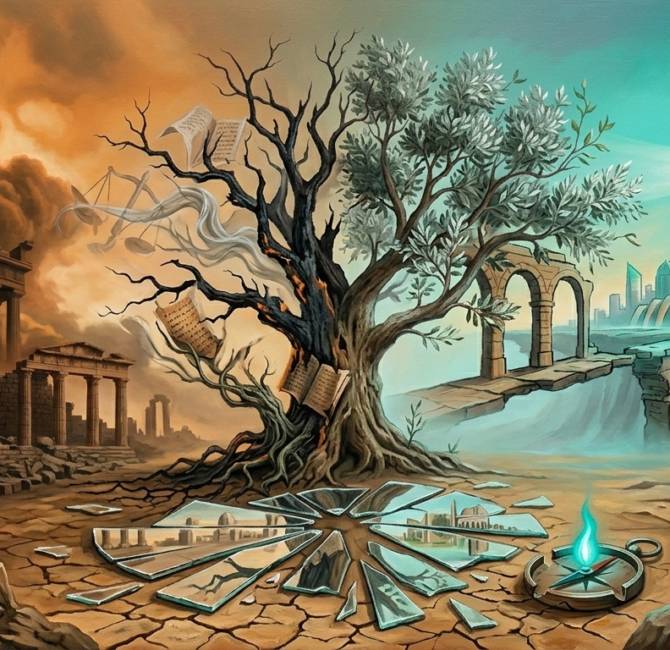
And the city, Swaida, conceals its profound contradiction between her sons’ craving for civilization and their loyalty to her past.
The Greeks did not endure in her soil, though they inscribed on her stones promises of eternity to their gods: (Sleep possesses you, O blessed one. O divine Sabnios, you shall live like the heroes and never die; you shall live reclining in the tomb, alive beneath the trees, for the souls of the pious shall live eternally).
She is the Nabataean Su’ada of black stone, born of her volcanic nature, beloved of her Nabataean god “Dhu al-Shara.” Dhu al-Shara died with the pagan eras, and his spirit reincarnated in a bird enamored of her lofty windows.
The Romans came and named her Dionysias after the god Dionysus; they engineered her quarters in Rome’s likeness, completing her with noble basalt and wagon-drawn wine. Then they erected the arch of the Little Byzantine Church as a beacon at her eastern entrance.
After the Romans, the city passed to the Ghassanid Arabs, then to Arab rule. In times of hardship and turmoil, she emptied save for some Bedouin tribes who frequented her springs in spring and departed. The Druze Arabs comforted her three centuries ago; Turks passed through their land and failed, followed by French armies.
Yet the spirits of their homes remained Arab, their names Arab; the bread in their homes is still called al-‘arabi, their coffee Arab, their attire Arab.
The ruins of an Ottoman fortress built in Swaida still stand. They departed, and she coos at sunrise. In the market’s heart remains a single abandoned inn, its roof collapsed, ivy tendrils dripping dew through its wall cracks, moss leaves whispering nostalgia.
Traces linger of the Lebanese al-Shuwayri architects, whom France imported from Lebanon’s Matn mountains to build a domineering ensemble for her colonial era: two-story buildings with tile-roofed verandas. The finest is Asmahan Palace, with its small window openings and vast surrounding grounds planted with exotic, alluring evergreens.
France departed, but the greenery did not.
The Little Church Arch became known as “the Gallows.” To its west, the Nabataean Syrian pool was buried; the reservoir that sustained people and land for centuries was filled in, and atop it rose a condolence tent site honoring death, watered by the living’s tears for the dead.
Remnants of a grand church persist, its stone vaults afflicted by abandonment, neglect, and filth. Beneath the earth lie two theaters, large and small.
In a solitary house near the buried theater lives a solitary old woman like it; every night she bathes, wraps herself in a white shroud, and sleeps in a stone sarcophagus that has stood in the house since before her birth.
The city retained her chronic poverty’s character, even as emigrants adorned her with mansions upon return.
Emigrants knelt in youth to passports that exiled them to diaspora, and in life’s autumn they fought desperately to return, acquire a goat pen for living, and a grave until death. They brought back Renaissance-style palace models, importing white or yellowish limestone from quarries in Duma, Hama, Aleppo, or Jordan?
Nigeria’s emigrants entrusted their palaces to one contractor, the khawaja Yusuf with his aristocratic accent, spotted pants and shirt, and ivory cane hooked to his chin. The khawaja built palaces while living in a caravan, astonishing the neighborhood boys with a house on wheels. He planted in the city and some villages designs of palaces he had built for Lebanon’s wealthy: vast homes, reception halls for a hundred guests, corridors like summer wedding venues, spacious garages, bedrooms with expansive en-suite bathrooms like squares. Houses yearning to be permanent homes for their owners, not mere stops sought in old age.
Editorial Conclusion: A Swaida as a Reservoir of Imagination and Social Transformations
The referential value of this text lies in its ability to document the “moment of fracture and transformation” in the structure of local society. Through her observation of the “emigrants'” phenomenon and their return with architectural models alien to the volcanic environment (limestone versus basalt), Abd al-Samad confronts us with the question of visual identity and its impact on dismantling traditional social cohesion in favor of the boasting of “prominent” and “obscure” families.
The transformation of the Nabataean “Syrian Pool” into a “condolence tent site,” and the “Church Arch” into “the Gallows,” are not mere literary images but documentation of a process of “reinterpretation of public space” in Swaida, where grief and catastrophic anticipation overshadow the space’s vital function. This text remains an essential reference for any researcher seeking to understand the “psychology of place” in southern Syria, and how ancient Nabataean myths reconcile (or clash) with the modern mindset of “Khawaja Yusuf” within a single geographical frame still searching for its quenching “water.”
Publication Information for Documentation:
● Author: Najat Abd al-Samad
● Source: No Water to Quench It, Najat Abd al-Samad, Difaf Publications (Beirut) and Atlass Publications (Algeria), 2017.
● Material Classification: In-Depth Analyses – Spatial Sociological Documentation.
● Original Language: Arabic (subject to translation under the magazine’s policy).
P.S: The original text, submitted by the author in Arabic, has been translated into French and/or English using artificial intelligence tools, with subsequent human revision to ensure accuracy. The original Arabic version remains the definitive reference for the author’s ideas, arguments, and scientific content, and is consulted in case of any discrepancies or interpretive issues between language versions
Swaida Intellectual Digital Magazine. (2026). Vol. 1(4). ISSN: 3099-3172 (online).