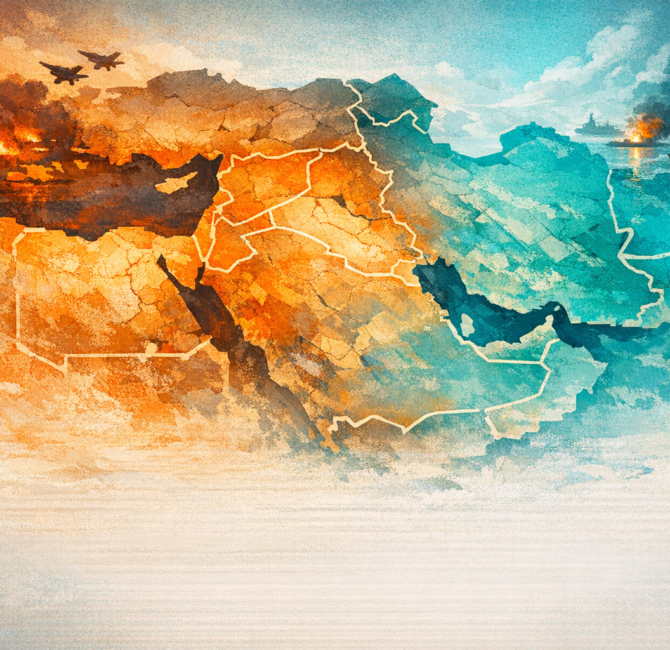


Introduction to the Digital Edition of Swaida Intellectual Review Magazine
Khaldoun Al-Nabwani stands out as one of the most prominent contemporary Syrian philosophical voices. He has earned his position through an intellectual project that blends deconstruction with a reading of modern political concepts. Hailing from Suwayda, Al-Nabwani moved to the University of Damascus before transferring to the Sorbonne, where he obtained his PhD in contemporary European philosophy in 2013. Since 2017, he has been an elected member of the Institute of Legislative and Philosophical Sciences in Paris.
His writings are distinguished by a critical analysis of modernity, the deconstruction of authoritarian systems, and an exploration of the relationship between literature and philosophy. This interview comes at a moment when philosophy intersects with questions facing Syrian society, as well as the intellectual and political transformations unfolding in the region. We meet him to explore his views on political concepts, modern rationality, post-war Syria, the role of philosophy in times of collapse, the position of Suwayda, and the problematics of identity, the state, and the future.
First: Philosophy, Deconstruction, and Method
- You have presented a philosophical project based on deconstruction without fully aligning with it. How do you understand deconstruction today, and is it still valid for reading the current Arab and Syrian political moment?
Deconstruction is primarily attributed to the French philosopher Jacques Derrida, yet in reality, it is an older philosophical tradition that extends beyond the young Derrida’s process of deconstructive reading of texts. Deconstruction, as I understand it at least, is a process of unveiling that delves beyond the apparent surface of data, facts, discourses, texts, slogans, news, and images. It reveals both overt and hidden active mechanisms, searching for concealed factors and latent causes behind any event. It is also an attempt to expose what has rusted, hardened, and petrified after once being a factor of progress, revolution, and upliftment in a bygone era—now necessitating the stripping away of its apparent surface to uncover the conceptual sterility beneath. In this sense, deconstruction becomes a broad school that goes further than Derrida, toward Marx himself, Nietzsche, Freud, and Michel Foucault, among others.
In this sense, deconstruction is not merely an intellectual tool limited to uncovering political sterility; it is also an urgent and necessary need for understanding the mechanisms of control and the processes of obfuscation lurking behind glittering concepts and slogans. Deconstruction, from this perspective, unveils illusions and the ways in which political discourse manipulates minds; it strips bare the mechanisms of media and ideological brainwashing. Politically, then, deconstruction becomes an enlightening process that reveals what has been hidden—or more precisely, concealed and falsified—as if attempting to convince people that tar is white, that the dictator is the pillar of the country’s and people’s security, that tyranny is democracy, that fragmentation is unity, and that the notion of the nation they present to us is nothing but a prison in which they confine us, making us sacrifice our lives in service of their family and personal interests, their insatiable pursuit of more wealth, power, and domination.
What is often held against deconstruction in general is its confinement to processes of revelation, stripping bare, and exposure without offering alternatives. For this reason, I personally move beyond deconstruction toward reconstruction after deconstruction—that is, presenting alternatives and solutions for what has been shown to be corrupted or no longer viable. After exposing flaws, defects, and diseases, the work involves treating them, changing the adopted approach, or completely exiting a conceptual cage that has not fully eroded and is now only fit for discard. Throughout all this, the compass must remain the dignified life of people—that is, citizens in the state and society—and their freedom, opening the space for them to realize their selves.
The employment of deconstruction in politics was one of the fields I have worked on, presenting a series of lectures, articles, and analyses through the deconstruction of political concepts, focusing on their practices in the Arab context.
- In your works, there is a clear interest in deconstructing political concepts (the state, modernity, progress, freedom). What makes political concepts in the Arab context more ambiguous or problematic than in other contexts?
Because these concepts have remained hybrid in their Arab contexts, both theoretically and practically. Concepts such as the state, modernity, civil society, democracy, secularism, citizenship, and the like are generally Western concepts. What I mean here is that their theoretical formulations emerged in the modern Western context (even democracy took on a new dimension from what it was among the Greeks, for example). Now, when examining the actual Arab political equation of these concepts—that is, their practical embodiment in institutions, ideas, and political practices—the hybridity becomes apparent. The Arab state is not a state fully embodying the modern Western meaning of the term, nor have Arabs undergone genuine experiences of enlightenment, modernity, liberalism, and progress. Therefore, the researcher among us needs contemplation and ijtihad (independent reasoning) in the Arab reality, where relying solely on Western theoretical analogy is insufficient for deconstructing this hybrid and wavering reality, caught between the achievements of Western modernity and the backward Islamic tradition deeply rooted in consciousness and mindsets.digitalcommons.
- How did your studies at the Sorbonne and your engagement with contemporary European thought shape your own intellectual project? And do you see yourself as having surpassed the European school toward formulating a Syrian or Arab approach?
There is no doubt that studying at the Sorbonne equipped me with a set of professional conceptual tools that I could not have acquired had I remained in Syria and its dilapidated universities. It was an opportunity for me and others who studied in the West to develop our theoretical and methodological toolkit, to professionalize scientific research in writing, teaching, and language. Personally, like many others from Third World countries who studied in the West, I became hybrid in civilizations and cultures—but in an enriching way, even if remaining an expatriate. There is no doubt that I changed in French universities, but the Easterner, with the concerns of his world, country, and people across the sea, continued to inhabit me. Between East and West, I discovered the stranger, who is myself, and how my psychological dimensions became no longer clear but hazy, my identity boundaries mixed—so neither fully Eastern nor Western, and paradoxically, both at once. Arab culture inhabits me just as Western culture does, and I write drawing from both directions, from right to left and vice versa. But it seems that the First World dominates my new world, as my preoccupations remain greater with what happens among the Arabs. I write more in Arabic and—with the near exception of purely Western academic research—occupy myself more with Arab issues and concerns. Since my influence in the West is almost nonexistent for now, I have some presence in the Arab world. I do not consider myself an exceptional case in this regard. I recognized myself, or rather my estrangement, in some works by Arabs who came to the West to study like me—for example, in Excerpts of Pure Gold in Summary of Paris by al-Tahtawi, in The Days by Taha Hussein (specifically the third part where he recounts his arrival in France on a scholarship to study), as well as in A Sparrow from the East by Tawfiq al-Hakim or Season of Migration to the North by Tayeb Salih.
As for my intellectual project, I was consciously aware, to have my own project, of the necessity to be myself as I am—estranged from both West and East, enriched and saturated by both. That is, filled by them and liberated from them.
Second: Literature and Philosophy
- You write extensively about the relationship between literature and philosophy. What does literature add to philosophy in the Arab context? And is contemporary Arab literature capable of carrying philosophical questions, or is it constrained by symbolism and censorship?
Allow me to recall here the distinction I recently made in my book The Migrant Logos (2025) between logos and reason, both of which philosophy is attributed to. Philosophy in the dominant Western scholastic sense today—and since Plato—is rational philosophy, the philosophy of causal, demonstrative reason and its derivatives from empirical, materialist, and scientistic philosophies. In contrast, logos—philosophically older and broader than reason—does not exclude rhetoric, poetry, and literature from its domains, unlike strict rational philosophy. In this sense, the relationship between philosophy and literature is linked to logos, not reason; and in this sense also, logos, Eastern in birth and spirit, is Arab as well.
In the Arab world, poetry historically dominated all forms of literature. Although the Arab was influenced by the West literarily and imported the novel and short story—after they had been limited among Arabs to narrative and epic styles like One Thousand and One Nights, The Tales of Banu Hilal, and al-Zir Salam—poetry remained the strongest and most present in the Arab context, even philosophically, sometimes to the detriment of philosophical thinking. I mean here that the poetic dose in Arab philosophical treatment is excessive, leading to a greater presence of Sufism and rhetoric than reason and logic among us.
Despite Arab literature being largely governed by symbolism resulting from overt and covert external and internal censorship, it is—perhaps because of that—capable of producing literary/philosophical works. Naguib Mahfouz comes prominently to mind in the Arab case. Mahfouz, the Nobel Prize winner in literature, is par excellence a philosopher/novelist. Mahfouz studied philosophy and produced literary works replete with profoundly important philosophical reflections; this is not limited to Children of Our Alley but extends to his entire body of novels and stories.
- In your readings of works like those of al-Tahtawi or Habermas, how do you reshape the relationship between the literary text and the philosophical text, and what creates the difference between them in constructing meaning?
Let me clarify that reading Habermas’s works did not greatly help me link philosophy to literature—except in a reverse manner. Habermas is a very important political thinker, social and legal theorist, but—unlike the first generation of the Frankfurt School—he does not actually concern himself with literature or art. His writing style is dry, reportorial, cold, governed by procedural rational language; literature and art appear in his work only very rarely, and only when critiquing them. For this reason, after completing my master’s thesis at the Sorbonne on rationality and modernity in Habermas, I felt a psychological need to add a philosopher who could quench the soul that Habermas’s procedural rational writings had dried up. I thus worked on Derrida; and my choice of Derrida at Paris 1 Sorbonne, where I wanted to continue for practical reasons, would not have been possible without pairing it with a rational philosopher like Habermas.
When the Institut du Monde Arabe in Paris commissioned me to write a book on al-Tahtawi, I reread his first and most famous book, Excerpts of Pure Gold in Summary of Paris, with more literary pleasure than intellectual. In France generally, al-Tahtawi’s book is classified as travel literature, and I classify it also as autobiography, a literary genre in its own right. Unlike al-Tahtawi’s later works, this book remains a unique literary masterpiece. But what bothers me in Arab intellectual writing is the excessive and intrusive insertion of poetry—which is the origin of philosophical logos—in a manner that harms both the literary and intellectual content. This intrusion annoyed me in many old and modern Arab intellectual works, making it seem like a display and digression inside, outside, and alongside the subject.
By contrast, I celebrated the relationship between the literary and the philosophical in my work on Ibn Tufayl in his famous philosophical story Hayy ibn Yaqzan, which I consider the first philosophical novel written in history. If Pythagoras, Heraclitus—even Parmenides—formulated their philosophy in poetic language, and if Plato was the first to dramatize philosophy by presenting it in the form of theatrical dialogues, then Ibn Tufayl was the first to write the philosophical novel, preceding later Western novelists.
In all cases, I acknowledge that the relationship between literature and philosophy has been fundamentally present in my reading and reflection on Western production from the Greeks to today: from pre-Socratic philosophers to Derrida, passing through Nietzsche, Freud, and Sartre. Moreover, literature has formed an essential and important part of my theoretical and intellectual arsenal, from Homer and Hesiod, the Greek theater of Sophocles and Aeschylus, to Milan Kundera, passing through Kafka and Nikos Kazantzakis.
Third: Syria, the State, and Society
- Syria has undergone major transformations over the past decade that have shaken the structure of the state and society. From a philosophical perspective: How do you read the disintegration of the Syrian state? And are we experiencing the collapse of a political model or a transition to a new model whose features have not yet become clear?
You mentioned in your question the terms “the state” and “society,” and it is necessary to distinguish in the Syrian case before 2011 that we had a Syrian state, but no political society—nor even a civil one—since the end of the 1960s in the last century. In the often reciprocal relationship between state and society, the state swallows society entirely in dictatorships and totalitarian regimes, leaving no civil society, no political movement, no popular participation in politics, not even parliamentarians freely chosen by the people at the minimum level. Such was the case of “Assad’s Syria” from the beginning of the 1970s until the moment of Bashar al-Assad’s flight. But if we had a state without a people during the Assads’ era, what has happened since the beginning of 2011 until today is a steady disintegration of the state and its apparatuses, as well as a sudden breakdown of social values.
What is happening today in Syria is thus a double collapse: the disintegration of the modern civil structures of the state and the breakdown of social, national, and even ethical values at the bare minimum for a single people’s existence. Today, with the arrival of a power with a jihadist past, a narrow factional mentality, and near-total monopoly of power among its members, Syria (or what remains of it) is heading toward a pre-state phase: that is, the Islamic ummah, the clan or sectarian tribe. I was the first to point to the “Bedouinization” of Syria, which is now emerging with the new power’s assumption of rule. During the Assad era, prominent social theories emerged and spread about how Hafez al-Assad ruralized and militarized Syria; today, we can speak of the Bedouinization of Syria in the Khaldunian sense of the term. Ibn Khaldun distinguished between Bedouinism (badawah) and urbanism (umran) and traced a historical line for civilization in which the nation ascends from Bedouinism to urbanism. What we observe today in Syria is a historical regression from the stage of urbanism (i.e., the state here) to the pre-state stage: Bedouinism and asabiyyah (group solidarity, sectarian in the Syrian case). I am not criticizing here the authentic values of Bedouins, but speaking of civilizational regression from the state (even in its terrifying military-security form under Assad) to the stage of the Islamic ummah as it was in the Middle Ages.
The Bedouinization of the country does not manifest only in appearances like long beards, gallabiyyas, sandals, “shahatat” (turbans), daggers, and swords, but in the crude tribal asabiyyah that not only precedes the state stage but hinders arrival to it and works to demolish what has been achieved in it.
I believe that, given the external conditions imposed on the new administration, al-Sharaa seeks a middle ground that does not deviate from his deeply rooted religious creed in an Islamic state, on one hand, and from Western conditions in combating terrorism, on the other. What is this solution? A moderate Sunni emirate. Al-Sharaa aspires to make Syria an emirate like the Gulf states, but this is impossible for two reasons: the first is the Gulf states’ shift from Bedouin asabiyyah toward modernization, openness, and combating Salafism—that is, from Bedouinism to urbanism, as in Saudi Arabia and the UAE; the second is Syria’s lack of oil and energy resources that could grant it an economic position allowing acceptance and stabilization of an emirate system.
- How do you see the relationship of the Syrian individual to the state today? And is the citizen still capable of imagining a unifying state after the bitter experiences of war, power, and polarization?
Unfortunately, the terms “the individual” and “the state” remain deficient in Syria. The individual is an independent person with free thought who realizes his individual existence alongside social engagement, but masses dominate in Syria and eradicate any individuality. They are sects, groups, majorities and minorities, clans and tribes, etc. In such masses, everyone merges and becomes part of a whole that erases their individual identities, intellectual independence, and personal will. Indeed, exiting what Nietzsche calls “the herd” becomes treason: “deviating from the group and breaking the stick of obedience.” Moreover, the concept of the state today in Syria is witnessing a rapid regression to the pre-state stage: the Islamic ummah or the state of the majority based on asabiyyah; and this sectarian ummah is based on masses as well and rejects individual differentiation.
The situation is no better with the term “citizen,” who has perhaps never been born in Syria throughout its entire history. The citizen exists in the citizenship state that equalizes everyone, does not kill or exclude them, and differentiates based on identity, religion, region, or wealth. We were—and remain—in Arab countries subjects, not citizens, to borrow the title of Egyptian thinker Khalid Muhammad Khalid’s book; or the “individual” among us remains a sujet (subject), far from becoming a citoyen, to borrow the French language’s distinction between the free citizen and the individual whose political existence is defined by subservience to the ruler. Hafez al-Assad consolidated the pillars of a military state that swallowed society whole and eradicated the aristocratic elites. Then, the secular orientation proposed by Ba’ath theorists was translated into closed sects and religions in separate circles without military or sectarian friction, but without working to create the only possible alternative: establishing a citizenship state instead of suppressing sectarian conflict by burying it.
After his sweeping victory in his bloody war against the Muslim Brotherhood in the early 1980s, Hafez al-Assad could have taught Syria in the manner of Bourguiba in Tunisia or Ataturk in Turkey, but he did not. By then, he had tightened his grip on Syria and was not thinking of the nation but of stabilizing his rule and bequeathing it.
Then, the suppressed sectarian monster began to emerge from its bottle with the revolution against Bashar al-Assad’s regime. The use of military force, explosive barrels, killings in prisons, etc.—what we know of the military solution pursued by Assad, especially in Sunni majority areas—intensified sectarian hatred to the point that it seemed like an approaching fire that would burn the frail thread remaining between Syrians. The arrival of the new administration with its jihadist background and references that surpass even Ibn Taymiyyah’s narrow views on sects and minorities has unleashed sectarianism. The new power opened Pandora’s box of sectarianism, from which all suppressed bloody Salafi monsters emerged. Defining Syria’s identity as an “Umayyad Sunni state,” then concentrating rule in the hands of Hay’at Tahrir al-Sham, and what its security forces or auxiliaries committed in massacres in minority areas on the coast and Suwayda, has transformed the “project” of shared coexistence into sectarian hatred and identity-based vendettas. There is no national project based on a citizenship state in the mind of this new administration; rather, their utmost concern is calming the internal situation by attaching minority sons to the state as dhimmis or third-class subjects, granted peace in exchange for absolute loyalty to the Sunni state. We are thus very far from the idea of the liberal citizenship state where all citizens are equal before the law and enjoy the same rights and duties, even though Syria is heading toward relative stability summarized as: security in exchange for submission.
- In your opinion, can philosophical discourse play an effective role in moments of social and political collapse, or is philosophy only invoked in times of stability?
Let us be realistic and acknowledge that philosophy is not a magic wand capable of creating rapid changes in the state and society. Philosophy is part of culture that fosters awareness of freedom, rights, and duties, calling upon the human to defend his existence and rights. But cultural and intellectual work is cumulative and slow, requiring political or societal will to translate ideas of enlightenment, renaissance, and modernity into ideologies, parties, human rights institutions, the entrenchment of human rights, and defining the citizen’s relationship with power and the state—which should serve the citizen, ensuring his protection and dignified life.
If we return to ideas circulated, for example, as solutions to Syria’s internal problems—like “democracy,” “social contract,” “secularism,” “citizenship state,” “civil society,” “plural society,” or even “political dialogue,” etc.—these are all originally philosophical ideas that were born and discussed in their political and rights framework, transforming into political institutions in every state or at the level of relations between states.
In the absence of philosophy—that is, as independent critical thought in general and normative thought in the state and legislation—power succeeds in alienating people, brainwashing their minds, and turning them into mere subjects: submissive followers under the shepherd’s authority. The term “ra’iyyah” (flock/subjects) derives from “ra’i” (shepherd), who leads the herd, controls them, and has the right to slaughter them.
Philosophy in the Arab world is weak in this rights sense and is inherently combated by fundamentalists and extremists who control Syria today; philosophers and thinkers are excommunicated in the manner of “he who philosophizes becomes an infidel” (“man tamanataqa tazandaqa”), and there is promotion of obscurantism and backwardness at the expense of modernity, enlightenment, and rational thought. Illiteracy in its simplest form is defined as the inability to read and write. Philosophical illiteracy is the failure to teach society the basic principles of the citizen’s rights in his freedom, rights, and duties.
Unfortunately, Salafism and the military have managed to dissipate what Arab thinkers and enlighteners accumulated over decades—perhaps nearly a century now, from the Nahda era until today. Philosophy and liberatory thought are threatened today in Syria more than ever, with the arrival of a Salafi clerical power that deeply opposes freedoms and liberal ideas.
Fourth: Suwayda and Local Identities
- You are a son of Suwayda and follow the developments of its society closely. How do you describe the social and political transformations this society has been experiencing since 2011?
Suwayda did not become as beautiful, diverse, open, and close to me despite the geographical distance as it was during the time when the people of Suwayda went out to Dignity Square, expressing their aspirations for a democratic, secular, free Syria liberated from the Assad dictatorship in the most beautiful and refined ways. Dignity Square in Suwayda (which I unfortunately have not visited since 2009) became the house of beautiful Syria. I rejoiced in the will of the people of Suwayda and their encompassing national consciousness, and I danced with them from afar—even though I personally felt uneasy when some of them raised Druze flags at the gatherings, as I saw all of Syria in Suwayda.
Then came the catastrophic massacres in mid-July of this bloody year. The invading hordes from security forces and clans committed massacres amounting to war crimes according to international reports. The people of Suwayda were truly left alone in the face of the massacre, the jihadists, and the haters. The new power did not protect them but directed its swords at their necks, and al-Sharaa thanked the clans for their attack on Suwayda, encouraging one Syrian faction against another. Nor did Syrians as a people and intellectuals take a clear and genuine stance in rejecting the massacre; rather, it appeared as if sectarian division had led many Syrians to support the slaughter and justify it. Social media played a catastrophic role in fueling the unleashed sectarian monster, just as the official Syrian media first—and the Arab media supporting the new administration—played a deeply negative role in exonerating the killer and condemning the victims. All of this left a psychological wound among the people of Suwayda, who felt deceived and that they had been naive when chanting for one Syrian people and dreaming of a civil state for all Syrians without exception. The people of Suwayda were not rewarded for embracing Syrians from all the cities destroyed by the son of Assad, nor thanked for standing against Assad—such that Dignity Square in Suwayda was the last stronghold of civil protest against Assad’s tyranny—but the opposite is what happened, leading to a very violent reaction in Suwayda.
I believe one of the dangerous results (and how many there are, unfortunately) for Suwayda is this shift from societal openness to Syria and Syrians toward fear, suspicion, and distrust reaching the point of rupture, even enmity and a desire for separation among some who, unfortunately, are the loudest voices, most influential words, and greatest impact in that beautiful mountain city. I thus understand the violent backlash caused by the violations and massacres, but I am against countering extremism with counter-extremism, exclusion with exclusion, and escalation with escalation. Suwayda has not received its rights to this day, and it is necessary to continue demanding them and holding those responsible accountable; but I am against generalizing the moment and throwing the baby out with the bathwater, as the French proverb says. What is absent from Suwayda today is politics, in short, and what prevails is outbidding and bravado; whereas, to reclaim your rights, you need politics, not swaggering.
- Do you see Suwayda today as experiencing an identity crisis, or as reshaping its old identity in light of the collapse of the central state?
An identity crisis is not defined merely by alienation from your origins and past that shaped your identity, but—on the contrary—by your pathological regression to identity as the last homeland. Fanaticism over identity and viewing it as pure and pristine against other impure identities (in the manner of Hegel’s beautiful soul) is the greatest identity crisis one can experience: from being a person to becoming a mere fanatic. There is no doubt that Suwayda is experiencing an identity crisis today more than ever before. It is well-known that many sects in our region are closer to civil societies than religious ones. In Suwayda, there are general values (sometimes narrow and closed, like the issue of marriage outside the sect), but the possibility of building individual personality is available with wide margins. There was no significant influence of religious men on social life in that governorate, and there was almost never rigid thinking on sectarian identity; but after the barbaric attack Suwayda suffered and the feeling of abandonment by Syrians, it made its people regress strongly to their sect and become sectarian. Thus, under and after the massacres, Suwayda’s societal openness turned into sectarian fanaticism, outbid by some who claimed leadership of the square and whose voice became the loudest and strongest, overshadowing the rational civil voices that are branded as traitors if they deviate from the single crowd’s voice.
- How can the relationship of Suwayda to Syria as a whole be understood: is it heading toward more integration, or toward more particularity and withdrawal?
Once again, regression to narrow sectarian identity that sees itself as authentic and pure against the other—who has become an enemy—deepens rupture and isolation, helping to sever human relations, neighborliness, and coexistence. The moment of the Suwayda massacre was generalized, and judgments were generalized over Syrians as all having endorsed the massacre and participated in it with arms, support, or even silence and complicity. Absolutizing this generalization led to a frightening and erroneous outcome in absolute terms: the impossibility of living in Syria with Syrians.
Suwayda today needs the voice of reason and calm, not tightening the sectarian string as is happening now. I am in favor of not recognizing this power until a national government and citizenship state are established in Syria where all are equal without exclusion; but I am against rupture with Syria and Syrians all at once and forever as a result of a generalized and erroneous judgment.
Fifth: Philosophy and the Syrian Future
12. Do you believe Syria is capable of building a new social contract after everything that has happened? And what are the philosophical and political conditions necessary for a truly modern state to emerge?
The social contract requires free wills and social consciousness of shared living, managing public affairs, and a political system based on equality and social justice. Unfortunately, all of this seems absent in Syria today more than ever. The “social contract” thus presupposes a society that defines rights and duties and the form of governance from bottom to top—or from the individual to the state, passing of course through society; for the individual here is a social/political being. In Syria, as I mentioned earlier, the military state swallowed society under Assad, and today the Islamic state comes to eradicate even the small margin for the individual and individual freedoms. Even the social contract in the Hobbesian manner—where individuals cede their freedoms to an absolute ruler in exchange for his protection—has not been realized for us, as the state decides everything from above.
To achieve the Syrian social contract, we must step outside the box of power. The elites must begin this long and difficult process today with dialogue among societal elites on a national, non-sectarian basis; for the current power does not undertake this duty, nor is it in its program—in fact, it stands against it and would fight it if started. Nevertheless, we must restore the basic conditions of the social contract: free people in society. In this sense, the social contract must begin in what we call the public space among intellectuals, politicians, human rights activists, and thinkers, such that society defines the form of the state and its political system—not for the ruling power to impose everything from above by coercion. In short, the social contract requires citizens, not subjects. Thus, we must start where we should start: from the people, for they alone are authorized to govern themselves, define the shape of their life and governance system, who represents them and rules them, while remaining able to hold everyone accountable. But once again, it seems that the ideas of Western philosophers were realized only in the West, while citizenship and the social contract remain a fairy tale among us.
- What role can intellectuals—philosophers, writers, and thinkers—play in overcoming the logic of sects and closed centralisms?
I fear that this dialogue comes at a stage where I feel frustrated by the dark reality we are living, so my answers come frustrated and frustrating at once. Today, we witness globally a rise in political populism, the spread of the culture of triviality, and the hegemony of the image (the violence of the image, in the view of French philosopher Baudrillard) at the expense of political values, ethical standards, and academic norms. Perhaps it has always been thus, but the accelerating pace of the culture of “banality” and the “society of the spectacle”—to borrow some book titles—is something history has never known before. In America, a president rules who has been impeached in several cases, including rape, harassment, bribery, corruption, and tax evasion; and the far right rises strongly in Europe. In Syria, hordes of Salafi jihadists arrive with extremist interpretations, Ibn Taymiyyah’s fatwas, the dissemination of Ibn Abd al-Wahhab’s books, and calls to spread religious education in the manner of kuttab at the expense of modern scientific curricula. Salafi mosque sheikhs can brainwash an entire generation while the presence of thinkers and writers recedes in favor of empty influencers and TikTok owners and preachers of darkness.
The intellectual today finds himself facing a double task and sadly realizes that the world is drowning before his eyes, and the drowning mock him when he extends his hand while they head to the bottom. And yet, we must continue the work (as we are doing in this dialogue), even if we realize the world will drown—perhaps someone hears, and perhaps social actors find in what we say, write, and propose ideas and programs that can be worked on to build a ship that saves us all from drowning before it’s too late.
- What worries you most about Syria’s future? Sectarianism? The absence of the state? Or the transformation of society itself?
Everything you mentioned is worrisome and dangerous, each capable alone of destroying the country and its people; but with the absence of social consciousness and the plague-like spread of sectarianism in Syria, the national state is missed. Listen, I will tell you my vision for the path to salvation from dictatorships and extremists in Syria’s situation or even the rest of Arab countries. To resolve civil wars and conflicts, and in the absence of minimum social consensus, I place great reliance on the strength of the state and its civil institutions first. Yes, in this sense, the solution comes from above, not from below—contrary to the social contract—but with conditions.
If we had, as a first step, a strong state with national civil leadership that pledges to stabilize security, protect citizens, compel them to respect laws and fulfill duties, and at the same time commits to giving birth to its rival and competitor: civil society, nurturing it as a mother nurtures her young child until it grows strong and can defend itself—we would be on the right path. My words here do not contradict what I said about the social contract that starts from below to above; for it can start from above (especially in Eastern societies) if national will is present. Ataturk and Bourguiba taught their countries from above, and some states advanced due to the strength of the state and the national strategic plans of their leaders. Take Bismarck in Germany, for example. If the strong state can impose security, establish the rule of law, and allow the birth of civil society, then the latter will later create, through its competition with the state, a balance such that the state’s power diminishes in favor of society’s power, and the state transforms from a nearly absolute strong ruler into mere institutions that protect people and secure their interests.
But what is being proposed today in the Syrian case bodes no good. Rather, it makes us more pessimistic with the transformation of the state into a conservative, autocratic, sectarian Sunni emirate. In short, it will contain to a great or lesser degree—yet explosive at any moment—the three diseases you mentioned in your question.
Editorial Conclusion from the Magazine
With this, we come to the end of our dialogue with Dr. Khaldoun Al-Nabwani, in which we reviewed a range of problematic issues where philosophy intersects with contemporary Syrian reality. The meeting offered a critical reading of deconstruction, modernity, and the state, from a philosophical perspective that seeks to diagnose the causes of sterility in political and social structures.
The dialogue raised essential questions about the fates of “the state” and “society” in Syria, shedding light on the challenges facing the formation of national identity amid current sectarian and political polarizations. We also paused at the specificity of the situation in Suwayda—not merely as local geography, but as a laboratory for examining the possibility of resilience against the breakdown of civil values and the tendency toward identity withdrawal.
What this dialogue carries in critical theses on the “Bedouinization” of the political scene or the complexities of the social contract represents material for research and public discussion—precisely what the Digital Swaida Intellectual Review seeks to establish through its platform: presenting in-depth academic and intellectual insights that contribute to understanding the major transformations the region is experiencing, without confiscating the reader’s right to analyze these visions and question them according to the standards of reason and reality.
Published after review and approval by the guest.
P.S: The original text, submitted by the author in Arabic, has been translated into French and/or English using artificial intelligence tools, with subsequent human revision to ensure accuracy. The original Arabic version remains the definitive reference for the author’s ideas, arguments, and scientific content, and is consulted in case of any discrepancies or interpretive issues between language versions
Swaida Intellectual Digital Magazine. (2026). Vol. 1(3). ISSN: 3099-3172 (online).