
Al-Mashqouq: A Comprehensive Historical and Archaeological Study
Prepared and Documented by: Wadaah Al Hajaly
.
Introduction
Al-Mashqouq village represents a living model of human settlement history in Jabal al-Arab, where successive civilizations have left their mark from the Stone Age to the modern era. This report aims to document the village’s history and archaeological features based on field surveys and historical-archaeological sources, organizing the study into major themes covering geography, historical chronology, architectural landmarks, and inscriptions.
Section One: Geography and Modern History
Location and Nomenclature
Al-Mashqouq village is situated on a rocky elevation rising 1,240 meters above sea level, surrounded by volcanic hills and valleys that form a fertile plain. The village lies approximately 12 kilometers from the Jordanian border and 7 kilometers south of Salkhad city. It is bordered by several villages and topographical features, including: Anz, Sima al-Bardan, Tahwala, Qumayri, Tell al-Habs, and Tell Abdmar.
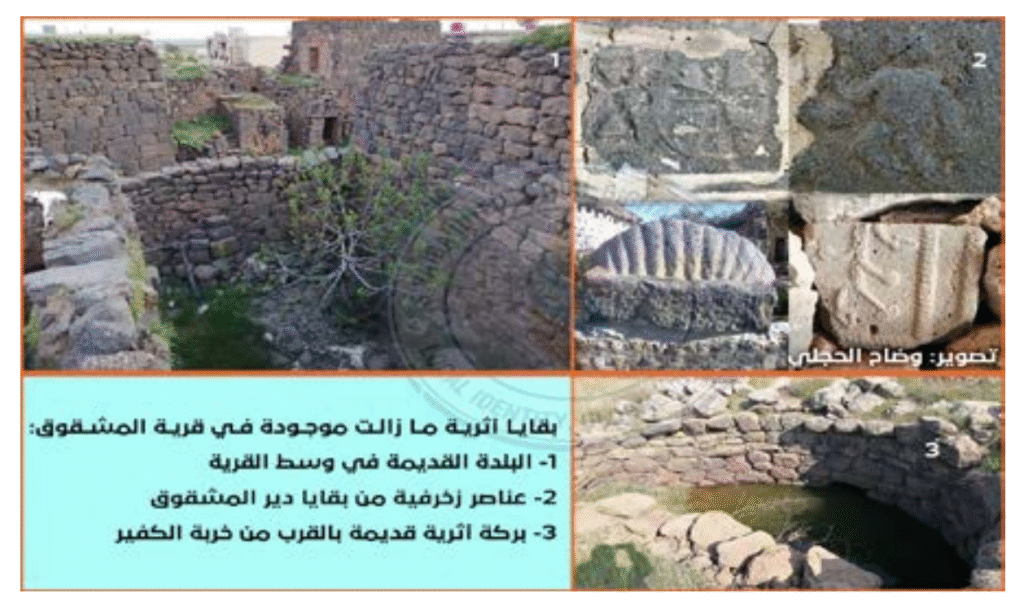
The name “Al-Mashqouq” is believed to be relatively recent, a modification of “Umm al-Shqouq” (Mother of Crevices), a name derived from the numerous large rocky crevices scattered throughout the site. These crevices, along with reservoirs and natural water basins (matkh), served as a principal water source. The village contains four ancient reservoirs, two of which have been filled in, as well as ancient wells and cisterns, including a large cistern in the Deir area that has been filled.
Modern Reconstruction and Settlement
The modern history of the village began around 1909, when it was resettled by families from Salkhad city, including the al-Hagli, Aziz, al-Shariti, Obaid, and al-Jammal families. The new residents restored ancient houses for habitation and reclaimed agricultural land.
During the past century, the village experienced urban development represented by the construction of distinctive heritage buildings, most notably:
- House of Selim al-Hagli (1910)
- Guest house of Abdullah al-Hagli (1921)
- House of the Mujahid Salih Aziz (1941-1947): considered one of the largest houses in the mountain, constructed on an area of 14 dunams, featuring a wall, three gates, and a large guest house
- House of Ali al-Hagli (1957): notable for its dated façade
- Primary School: dating to the French Mandate period

The village also contains a private museum holding heritage and archaeological artifacts that document the region’s history across the ages.
Section Two: Historical Chronology
The region has experienced intermittent settlement since the Stone Age, passing through Canaanite, Nabataean, Roman, Byzantine, and Islamic periods, culminating in modern settlement. Traveler Butler from Princeton University’s expedition described the village in 1905, referring to its lofty location and the good condition of its ancient buildings, and noted the use of stones from the Al-Mashqouq Monastery temple in the construction of private homes.
1. Stone Ages
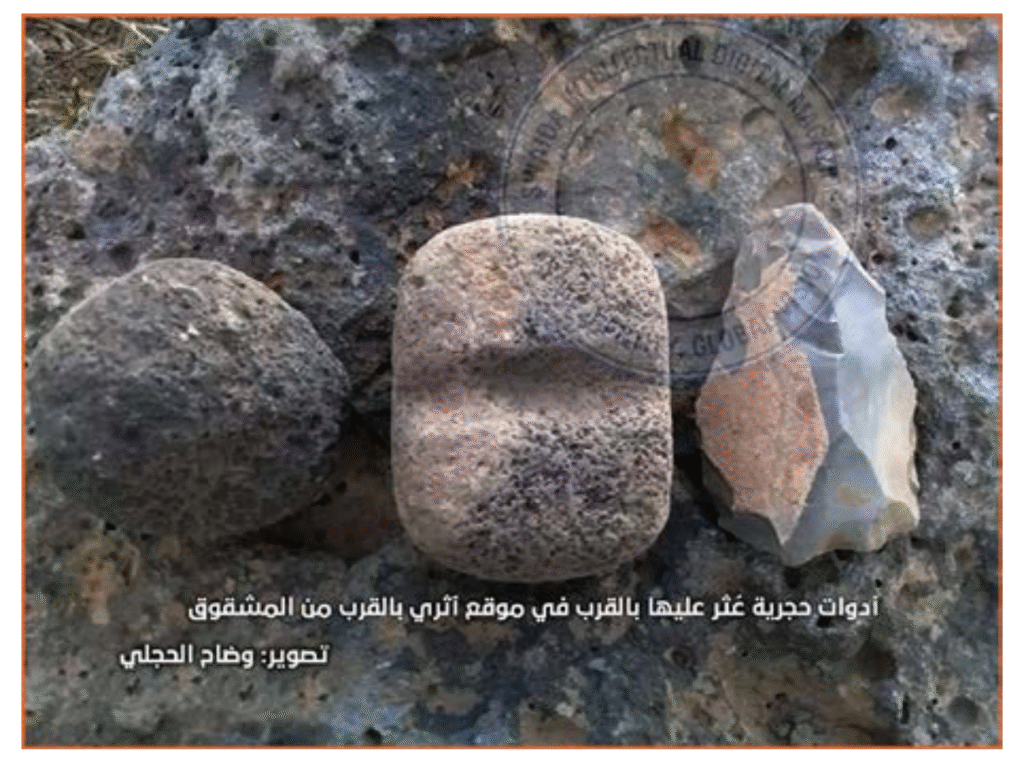
Field surveys indicate the presence of flint tools and heavy tool remains in the vicinity of the village, particularly in the “Ard al-Awjah” area west of the village. A flint axe, spearheads, and stone and basalt arrows were found near caves, indicating early human activity.
2. Bronze and Iron Ages
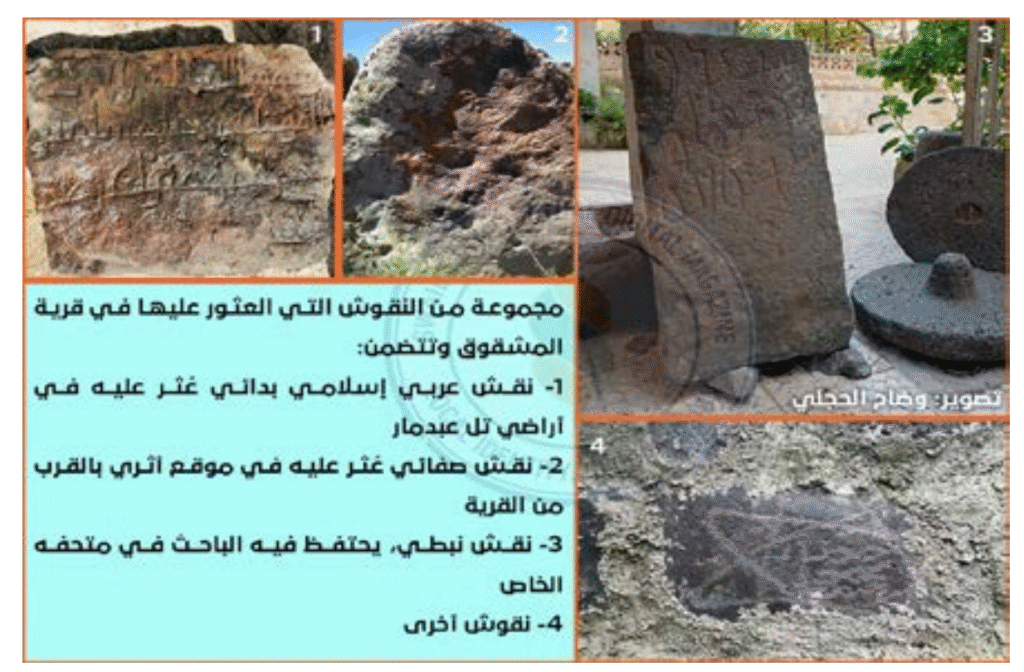
The region was connected to Canaanite and Amorite civilizations. Despite the scarcity of visible artifacts from this period due to successive civilizations, there are architectural indicators in one residence consisting of rooms and covered underground chambers built using the corbel-arch system and columns without arches, as well as an archaeological site north of the village containing pottery and inscriptions resembling Safaitic script, and remains of primitive buildings in the village’s vicinity.
3. Nabataean Period
The village is an important Nabataean site, containing prominent remains, most notably the Deir temple and Nabataean inscriptions, including an inscription in the Nabataean temple east of the village (Al-Mashqouq Deir).
4. Roman and Byzantine Periods
Most of the standing archaeological buildings date to the Classical period (fourth century CE and later). The most important landmarks include:
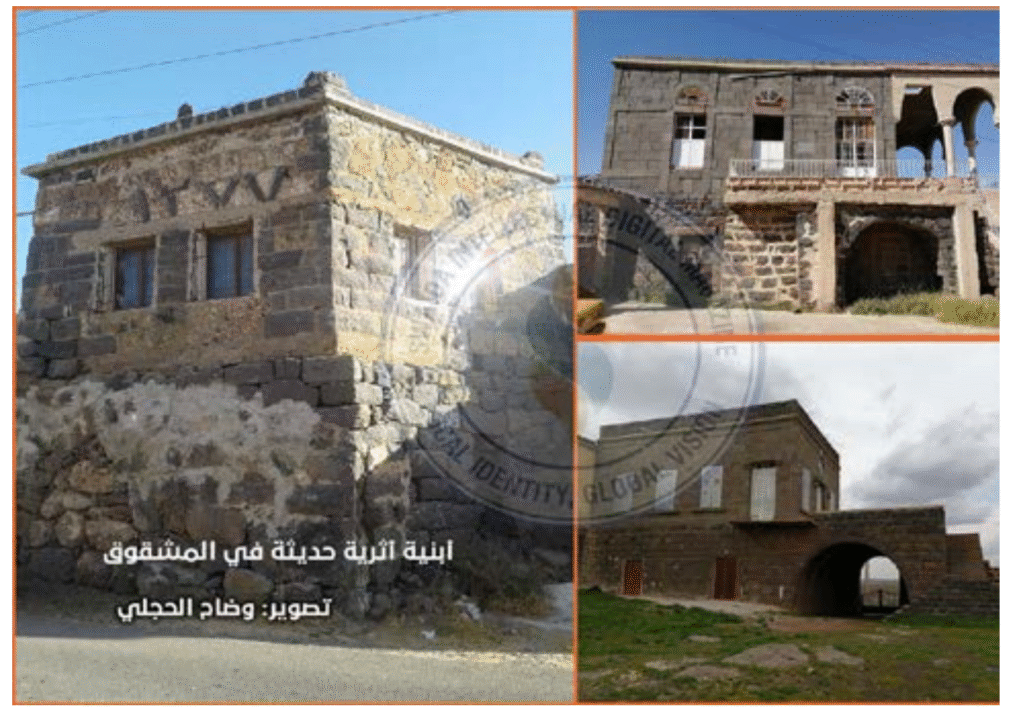
- A two-story residential building with a southern façade and a window with a stone awning
- An adjacent building with a paved corridor and stone gate
- Extensive vaults and stables that have retained their original form
- Greek inscriptions documenting the names of individuals and warriors, including funerary inscriptions
5. Islamic Periods
The village continued to flourish during the Islamic periods, serving as a defensive point during the Umayyad era. Settlement continued through the Mamluk period (fifteenth century), when ancient buildings were restored and new structures were added. Kufic inscriptions from the Abbasid and Umayyad periods have been documented, in addition to Ayyubid and Mamluk inscriptions.
Section Three: Archaeological Landmarks (The Tower and Al-Kufayr)
1. The Tower
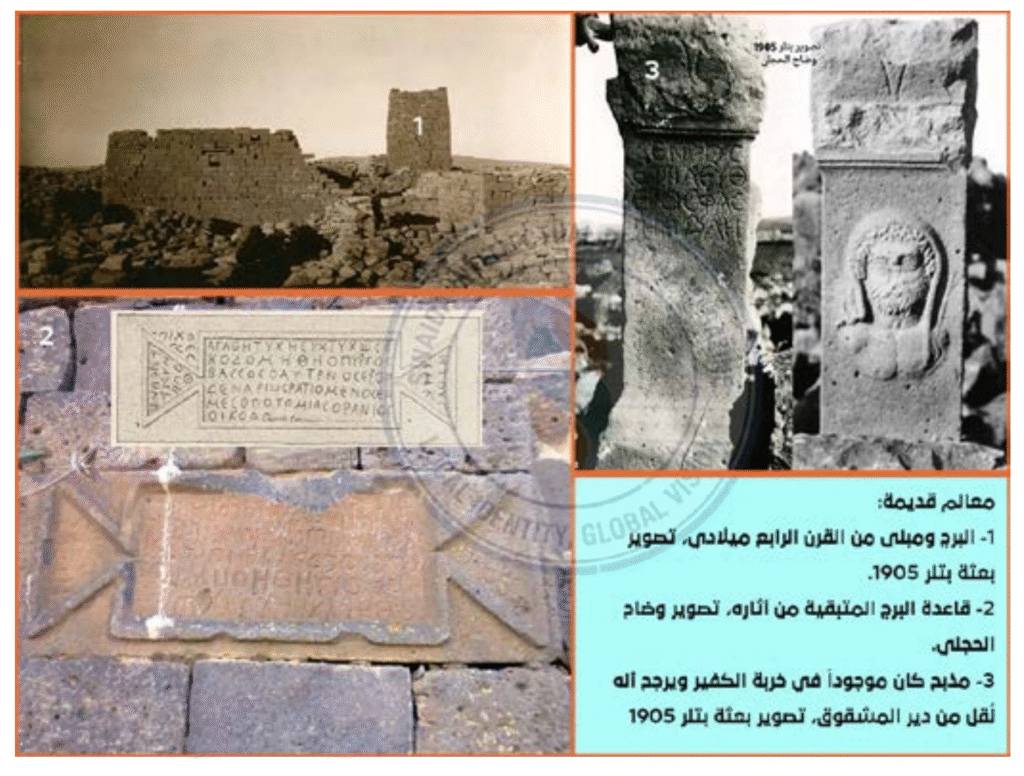
A large square tower formerly stood in the center of the village. French archaeologist Waddington described it during his 1861 expedition to Hauran. Butler documented the tower in 1905, noting its distinctive convex shape and the presence of defensive crenellations. A Greek inscription (inverted, indicating reuse) was found on its eastern façade, dating its construction to 351 CE.
Translated inscription text: “Good fortune! The tower was built successfully. Passus, an old warrior, former commander of a cohort, served in Mesopotamia. Syrianus was the architect. Expenditure: 10,000 times 1,575 dinars. Year 245 [Seleucid calendar, corresponding to 351 CE].”
The inscription indicates financial inflation during that period and mentions the architect’s name, “Syrianus.” The tower is estimated to have collapsed between 1905 and 1911, though its foundations remain within one of the ancient houses.
2. Khirbat al-Kufayr (Umm al-Blayat)
Located south of Al-Mashqouq, this archaeological site experienced settlement through the Mamluk period. Its buildings were dismantled and their stones used in neighboring villages (such as Anz).
The site contains ancient cisterns and wells, as well as the “Ein al-Kufayr” spring. Butler noted the absence of large classical structures, suggesting that the pagan reliefs and altars found in its later Christian buildings were transferred from the adjacent Al-Mashqouq monastery.
Most important inscriptions and finds at al-Kufayr:
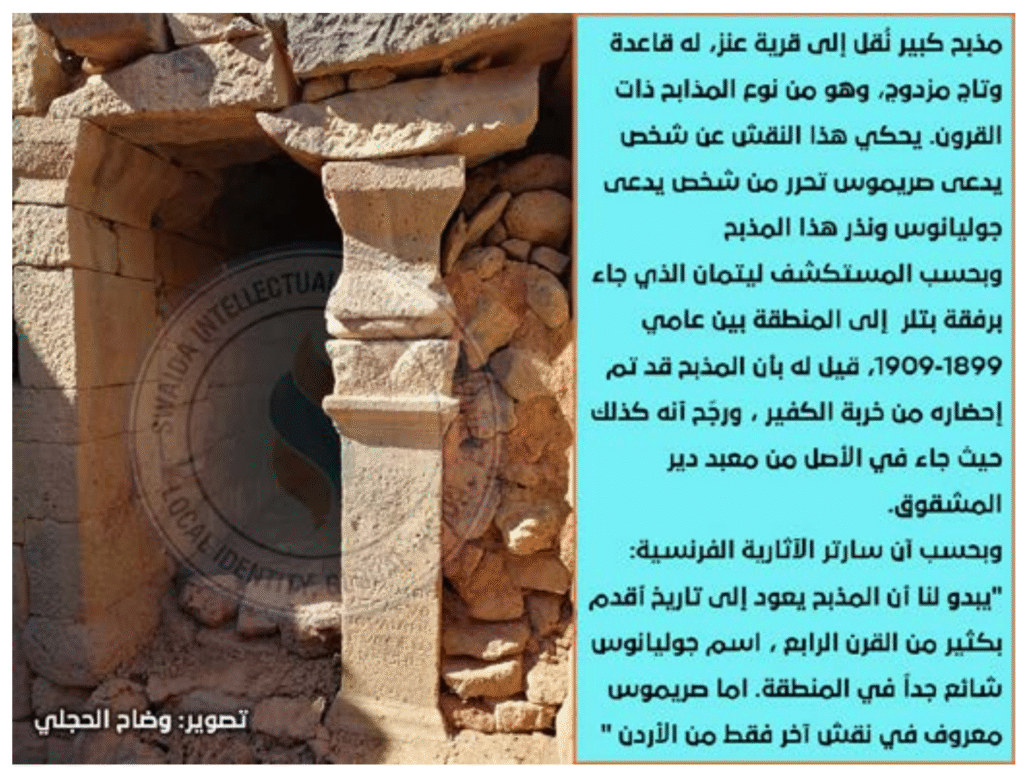
- An altar bearing a carved relief of a bearded man (believed to be Emperor Julian in priestly attire)
- A gravestone for a woman from the Hieronymus family (318 CE)
- A defaced inscription mentioning the construction of a “theatron” (amphitheater) attributed to the Al-Mashqouq temple
3. Al-Mashqouq Monastery (Deir al-Mashqouq)
The “Al-Mashqouq Deir” represents the most prominent landmark, despite its current ruined state. This site underwent multiple phases:
Nabataean pagan temple (second century CE): Built in the Classical style of the Hadrianic era (not the local Nabataean style of Se’a temples). A Nabataean inscription was found within, dated to the seventh year of Hadrian’s reign (124 CE).
Early Christian church: The columns and portico were removed and new walls were added.
Return to paganism (era of Julian the Apostate): Inscriptions (particularly one transferred to the village of Anz) indicate the temple’s reconstruction and reconsecration in 362 CE.
Christian monastery (sixth century): Construction expanded to include monastic buildings.
Medieval settlement.
Inscriptions associated with the Deir:
“Theatron” inscription: Indicates the presence of an amphitheater or courtyard for religious ceremonies attached to the temple, likely containing the main altar.
Nabataean inscription: “This altar, which Mu’ain son of ‘Aqrab built in the temple of the god Ashar, god of Mu’ain, in the seventh year of the Caesar Hadrian (124 CE).” The mention of the god “Ashar” (not “Asad” as previously believed) indicates a connection to the deities of Palmyra and al-Hatr.
Renovation inscription (transferred to Anz): Documents the temple’s reconstruction and reconsecration in 362 CE during the reign of Emperor Julian.
Conclusion
Al-Mashqouq village in southern al-Suwayda, through its architectural remains and scattered inscriptions, presents an important historical document of religious and social development in the southern Hauran region, and demonstrates the interweaving of Nabataean, Roman, Christian, and Islamic civilizations within a single urban fabric.
Refrences:
- Sartre-Fauriat, A., & Sartre, M. Inscriptions Grecques et Latines de la Syrie (IGLS), XVI, قيد النشر.
- Butler, H. C. Ancient Architecture in Syria: The Southern Hauran.
- Littmann, E. Greek and Latin Inscriptions in Syria: Southern Hauran.
- خلف، تيسير. دراسات في النقوش النبطية.
- المسوحات والتوثيق الميداني (وضاح الحجلي).
P.S: The original text, submitted by the author in Arabic, has been translated into French and/or English using artificial intelligence tools, with subsequent human revision to ensure accuracy. The original Arabic version remains the definitive reference for the author’s ideas, arguments, and scientific content, and is consulted in case of any discrepancies or interpretive issues between language versions
Al-Hajaly, W. (2026). Al-Mashqouq: A Comprehensive Historical and Archaeological Study. Swaida Intellectual Digital Magazine, 1(1). https://doi.org/10.5281/zenodo.19423059